
InterGedi Webinar 2026: Sharing findings from our SciDis project
On June 8th 2026, we organised a free, open-to-all, end-of-project webinar, titled “Towards informed and efficient expert knowledge communication”, where we shared core findings from SciDis with peers and other interested parties. Our SciDis project set out to investigate the “Processes of recontextualisation in the transfer of knowledge: A pragmatic, linguistic and multimodal study of digital scientific discourse for dissemination purposes” and was funded by the Spanish Ministry of Science and Innovation (PID2021-122303NB-100). The webinar was well attended by colleagues from different Spanish and international institutions.
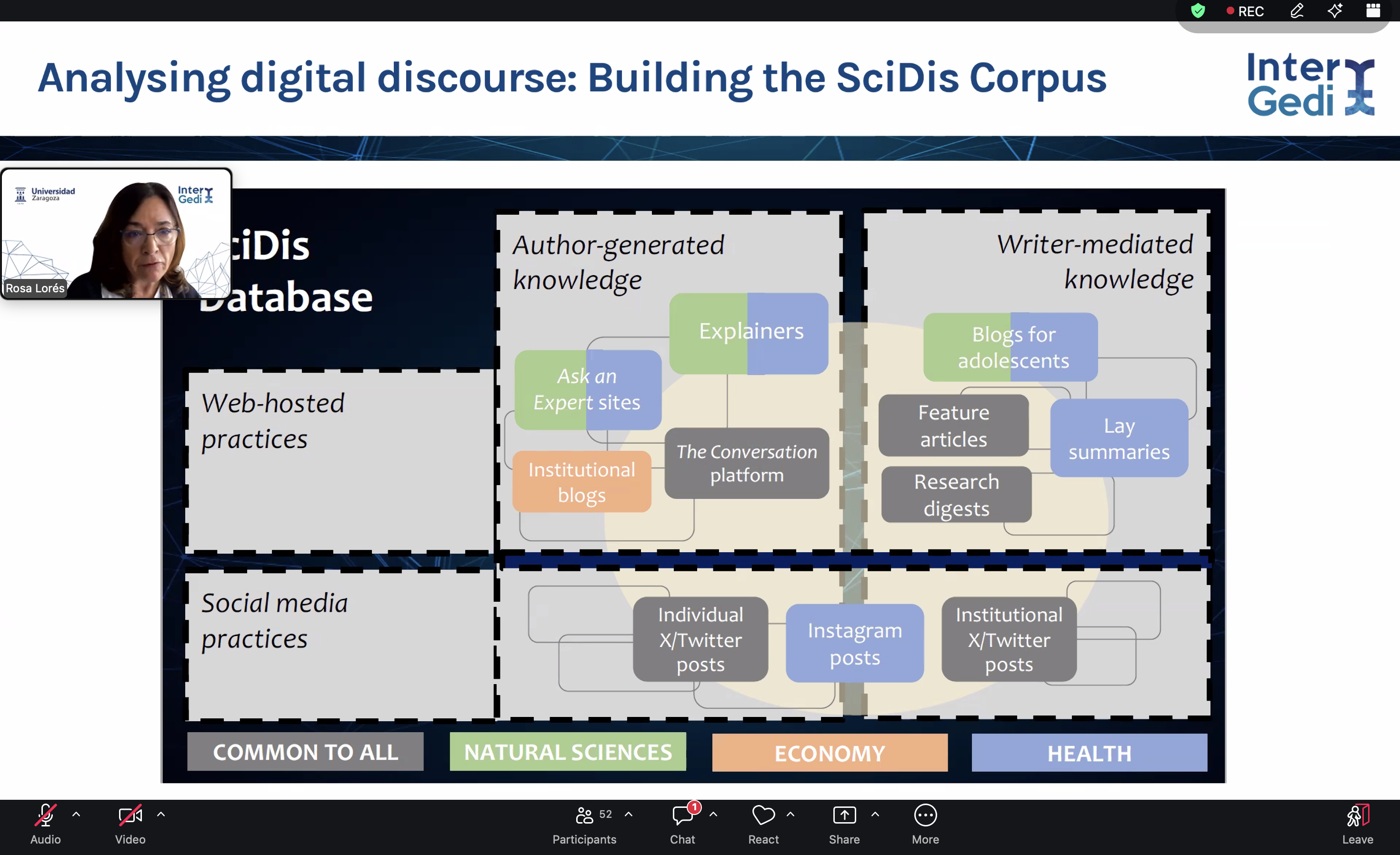
We began the webinar with Dr Pilar Mur-Dueñas‘s introductory remarks, who greeted the participants and stated the aims of this webinar. She then gave the floor to Dr Rosa Lorés, who moved on to present the rationale of the SciDis project by outlining some of the driving factors behind the need to research expert knowledge communication nowadays. She also explained the decision-making process followed to build and compile the SciDis Database. Afterwards, Dr Daniel Pascual proceeded to show the SciDis Deliverables, which we have made openly available on our website, spotlighting key overarching results in relation to linguistic and visual elements as well as general strategies used to digitally disseminate expertise to broad audiences.
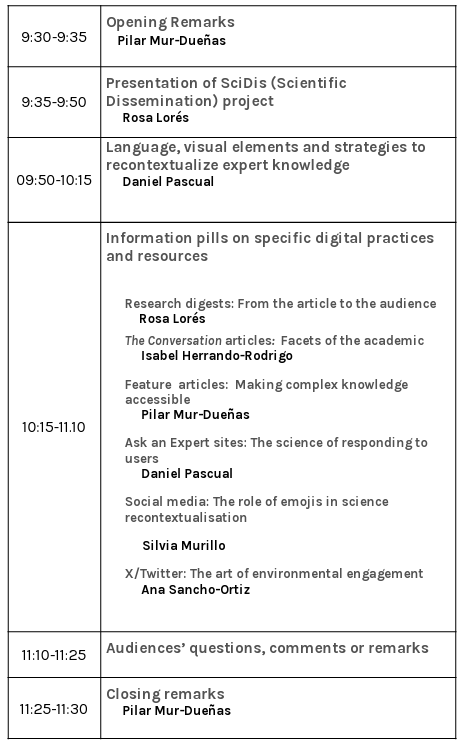
Next, we continued with the individual presentations delivered by some of our research members, who focused on discussing prominent discursive aspects that have been identified as typical of certain digital discourse practices. Firstly, Dr Rosa Lorés focused on “Research digests: From the article to the audience”. Then, Dr Isabel Herrando-Rodrigo targeted “The Conversation articles: Facets of the academic”, followed by Dr Pilar Mur-Dueñas, who looked into “Feature articles: Making complex knowledge accessible”. Later, Dr Daniel Pascual centred on “Ask an Expert sites: The science of responding to users” and Dr Silvia Murillo-Ornat discussed “Social media: The role of emojis in science recontextualisation”. Lastly, Ana E. Sancho-Ortiz concentrated on “X/Twitter: The art of environmental engagement”.
Before rounding off with some concluding remarks, we opened the floor to the attendees through a 15-min Q&A. Some very thought-provoking points were raised that allowed us to reflect on a range of issues, such as corpus representativeness or the intricacies of knowledge asymmetries, amongst others.
We would like to express our sincere gratitude to all the participants for joining us on this knowledge-sharing webinar and for posing so many stimulating questions! We are thankful for having reached this project milestone and for being able to disseminate our insights to society at large. Looking forward to pursuing our next research endeavours!