
InterGedi 2026: Lucía Lasheras looks into English phraseology and multimodality on Instagram
Our PhD student Lucía Lasheras presented at the InterGedi 2026 Conference, which revolved around “Digital recontextualization practices in expert knowledge communication”, taking place between the 18th and the 20th of March 2026. The organising committee was made up by InterGedi members Dr Rosa Lorés, Dr Silvia Murillo-Ornat and Ana E. Sancho-Ortiz. Our end-of-project conference was celebrated at the Faculty of Arts (University of Zaragoza).
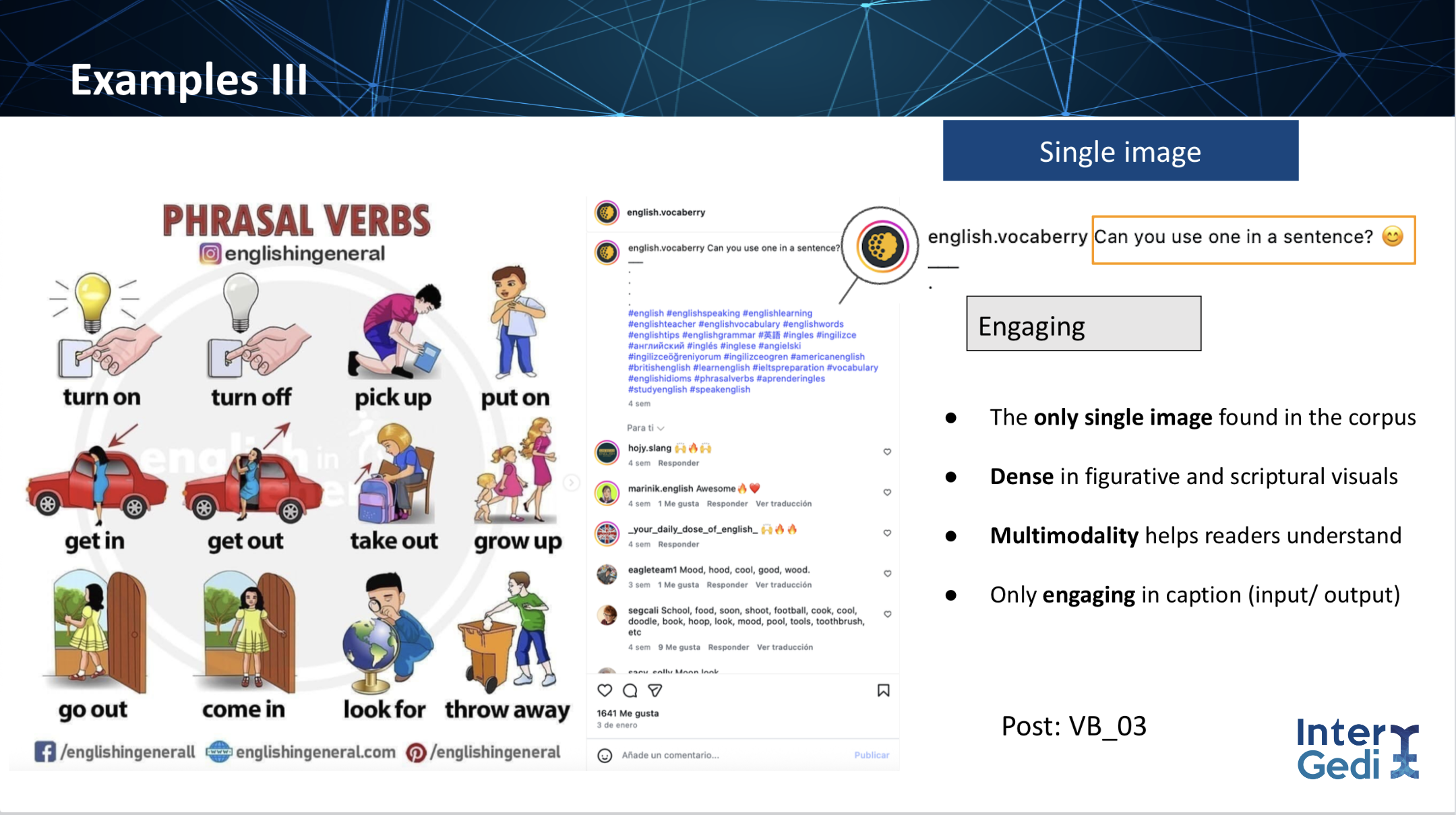
Lucía’s paper focused on “The use of Instagram for didactic purposes in English and Spanish: Recontextualizing English phraseology with a multimodal approach”. Her presentation contrasted how Spanish and English Instagram accounts exploited multimodal resources to disseminate phraseology to non-expert audiences.
You may find her abstract below:
The use of Instagram for didactic purposes in English and Spanish: Recontextualizing English phraseology with a multimodal approach
Digital genres have become a major trend in the dissemination of knowledge of any kind. Online platforms and social media allow experts and non-experts to communicate worldwide and share knowledge in different formats with broad and diverse audiences (Bondi & Cacchiani, 2021). One of the rapidly growing phenomenon is teaching and learning foreign languages through these sites, where different modes—such as gestures, images, emoji, and text—are used to enhance meaning and engagement, adapting specific contents to the general public (Lorés, 2023). Instagram, the focus of this presentation, is now a medium to share and recontextualize knowledge of varied areas, amongst which English as a Second Language (ESL) teaching is a predominant one (Nasution, 2023).
This presentation offers a qualitative and quantitative contrastive analysis of English L1 and Spanish L1 accounts disseminating English phraseology on Instagram. Its purpose is to examine how visual resources, together with text, are employed to achieve the intended communicative purposes and to connect with the audience. For this analysis, thirty posts corresponding to six accounts have been selected as a sample, following a set of criteria to achieve representativeness. First, a pragmalinguistic analysis of the captions has been carried out through the identification and classification of three main discursive strategies that are common in the posts. The format of the publications—i.e., single image, single video, cluster of images or videos, or combinations of these—has been considered afterwards. Then, the different multimodal elements have been explored, specifically the use of linguistic, figurative, and scriptural resources, among other elements (Luzón & Albero-Posac, 2025).
The combination of these three variables in the two L1 subcorpora allows us to spot common and divergent patterns in the discourse used on Instagram. It brings an in-depth understanding of how the platform is used nowadays to teach English as a Second Language (ESL), and the way different modes enrich the meaning and coexist in an attention-getting environment.
References
Bondi, M., & Cacchiani, S. (2021). Knowledge communication and knowledge dissemination in a digital world. Journal of Pragmatics, 186, 117–123.
Lorés, R. (2023). Dual voices, hybrid identities in digital dissemination. Círculo de Lingüística Aplicada a la Comunicación, 93, 69–84.
Luzón, M. J., & Albero-Posac, S. (2025). Disseminating research results in The Conversation: An analysis of comprehensibility strategies. Discourse, Context & Media, 67, 100920.
Nasution, A. K. P. (2023). Instagram in English language learning: A systematic literature review. Journal of Linguistics, Literature, and Language Teaching, 3(1), 33–52.