
InterGedi 2026: Daniel Pascual presents a netnographic study on scientific expertise online
Our team member Dr Daniel Pascual took part in the InterGedi 2026 Conference, our end-of-project conference themed around “Digital recontextualization practices in expert knowledge communication”. It was organised by Dr Rosa Lorés, Dr Silvia Murillo-Ornat and Ana E. Sancho-Ortiz and was held at the Faculty of Arts (University of Zaragoza), from March 18th to March 20th 2026.
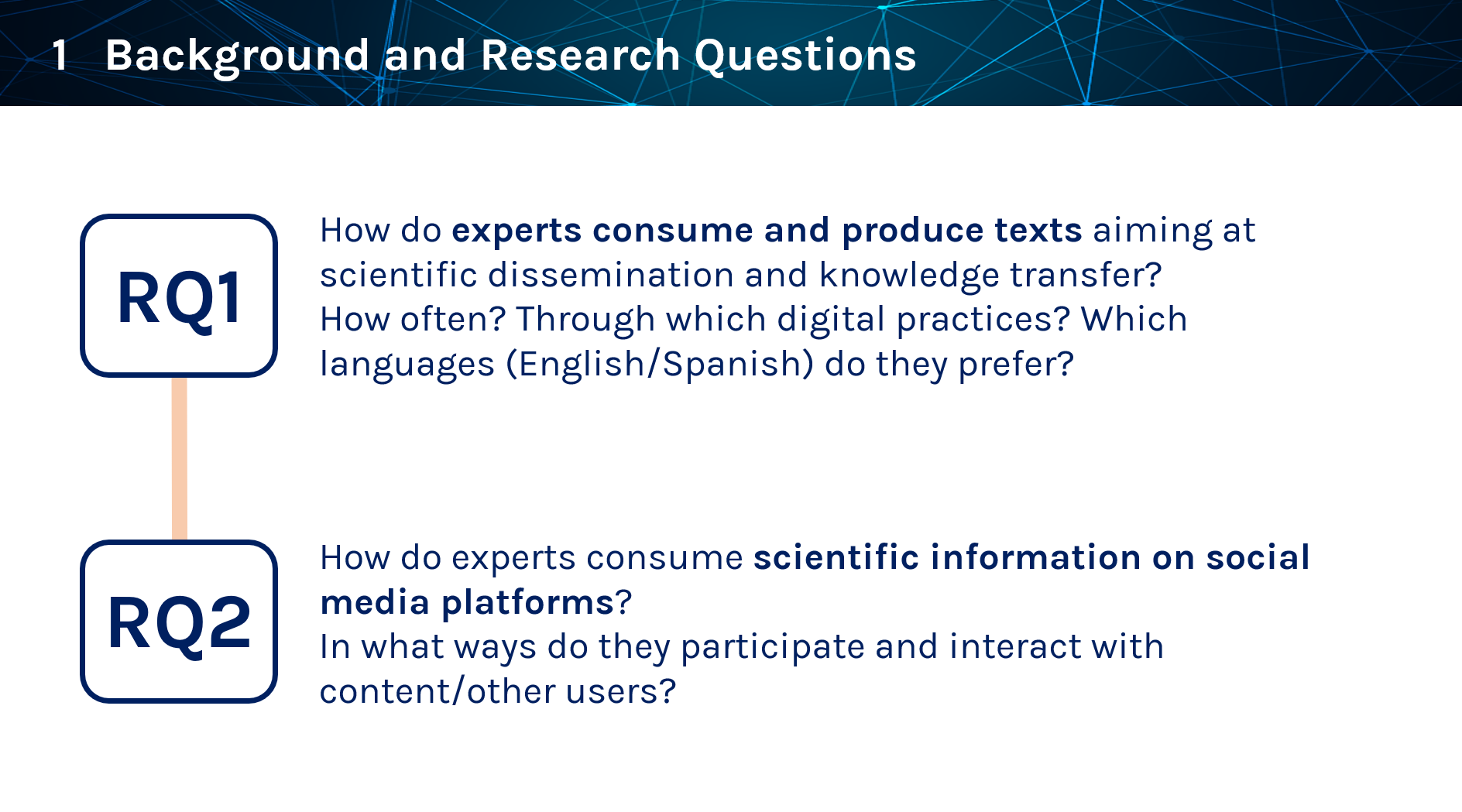
The paper Daniel presented was titled “Experts producing and consuming science online: A netnographic approach to attitudes and patterns of use towards scientific knowledge”. There, he shared the results of a survey and cast light on the attitudes held by expert users and on their consumption and production patterns concerning digitally mediated scientific expertise.
You can read his abstract below:
Experts producing and consuming science online: A netnographic approach to attitudes and patterns of use towards scientific knowledge
The relationship between science (in its broad conception) and citizenship has become increasingly bidirectional and close in the present decade. Scientists have increased their efforts towards knowledge communication and research dissemination (Bondi and Cacchiani 2021; Plo-Alastrué and Corona 2023), and heterogeneous users are now more interested in accessing scientific information about topics of societal relevance. Against this backdrop, the present paper seeks to investigate the attitudes and usage patterns of users who consider themselves “experts” in relation to scientific knowledge via digital media.
Drawing on netnographic approaches (Kozinets 2010), an online survey was designed to unveil the digital practices of both experts and non-experts in relation to scientific knowledge. It was revised by a group of researchers, piloted at an initial stage with external collaborators, and administered in October 2025 through social media profiles and e-mails to professional associations, institutional organizations and distribution lists. Therefore, the study relies on a non-probability convenience sampling strategy (Patton 2002). Six main disciplinary fields were purposefully targeted: economy, history, psychology, medicine, engineering, and linguistics. Emphasis was placed upon prominent digital dissemination practices included in the SciDis Database, comprising feature articles, research digests, knowledge-sharing platforms like The Conversation, Ask-an-Expert websites, explainers, podcasts, lay summaries, and social media like microblogging and image-based platforms (Pascual and Sancho-Ortiz 2024). Although the survey covered both experts’ and non-experts’ views on their practices regarding the consumption and/or production of science online, the focus of this presentation is placed on the responses of approximately 200 experts.
Results reveal that respondents most often turn to feature articles and The Conversation for English-language scientific content. On social media, YouTube leads as a source to enjoy dissemination efforts, followed by Instagram, X, and LinkedIn. Yet, most participants remain passive “lurkers”, interacting only by liking, sharing, or reposting. When it comes to publishing, feature articles and The Conversation again prevail, complemented by scientific podcasts and explainers of specialized topics. Respondents aim to boost the visibility and impact of their research and promote open science, whereas those who abstain mention time constraints and limited institutional or disciplinary recognition as the main factors. Overall, the findings reveal selective consumption and cautious, purpose-driven engagement with scientific content, alongside contextual constraints, which can help us understand the current landscape of digital scientific practices and how specialised knowledge is distributed online.
References
Bondi, M., & Cacchiani, S. (2021). Editorial: Knowledge communication and knowledge dissemination in a digital world. Journal of Pragmatics, 186, 117–123. https://doi.org/10.1016/j.pragma.2021.10.003
Kozinets, R. V. (2010). Netnography: Doing ethnographic research online. Sage.
Pascual, D., & Sancho-Ortiz, A. E. (2024). Investigating recontextualisation processes in scientific digital practices: The SciDis database. Revista Electrónica de Lingüística Aplicada, 23, 101–118. https://doi.org/10.58859/rael.v23i1.649
Patton, M. Q. (2002). Qualitative research & evaluation methods (3rd ed.). Sage.
Plo-Alastrué, R., & Corona, I. (2023). Digital scientific communication: Identity and visibility in research dissemination. Palgrave Macmillan. https://doi.org/10.1007/978-3-031-38207-9