
InterGedi 2026: María Fanlo-Piniés analyses TED talks multimodally
Our team member Dr María Fanlo-Piniés participated at our InterGedi 2026 Conference, titled “Digital recontextualization practices in expert knowledge communication”, hosted between March 18th and 19th, 2026. This conference was organised by our team members Dr Rosa Lorés, Dr Silvia Murillo-Ornat and Ana E. Sancho-Ortiz and took place at the Faculty of Arts (University of Zaragoza).
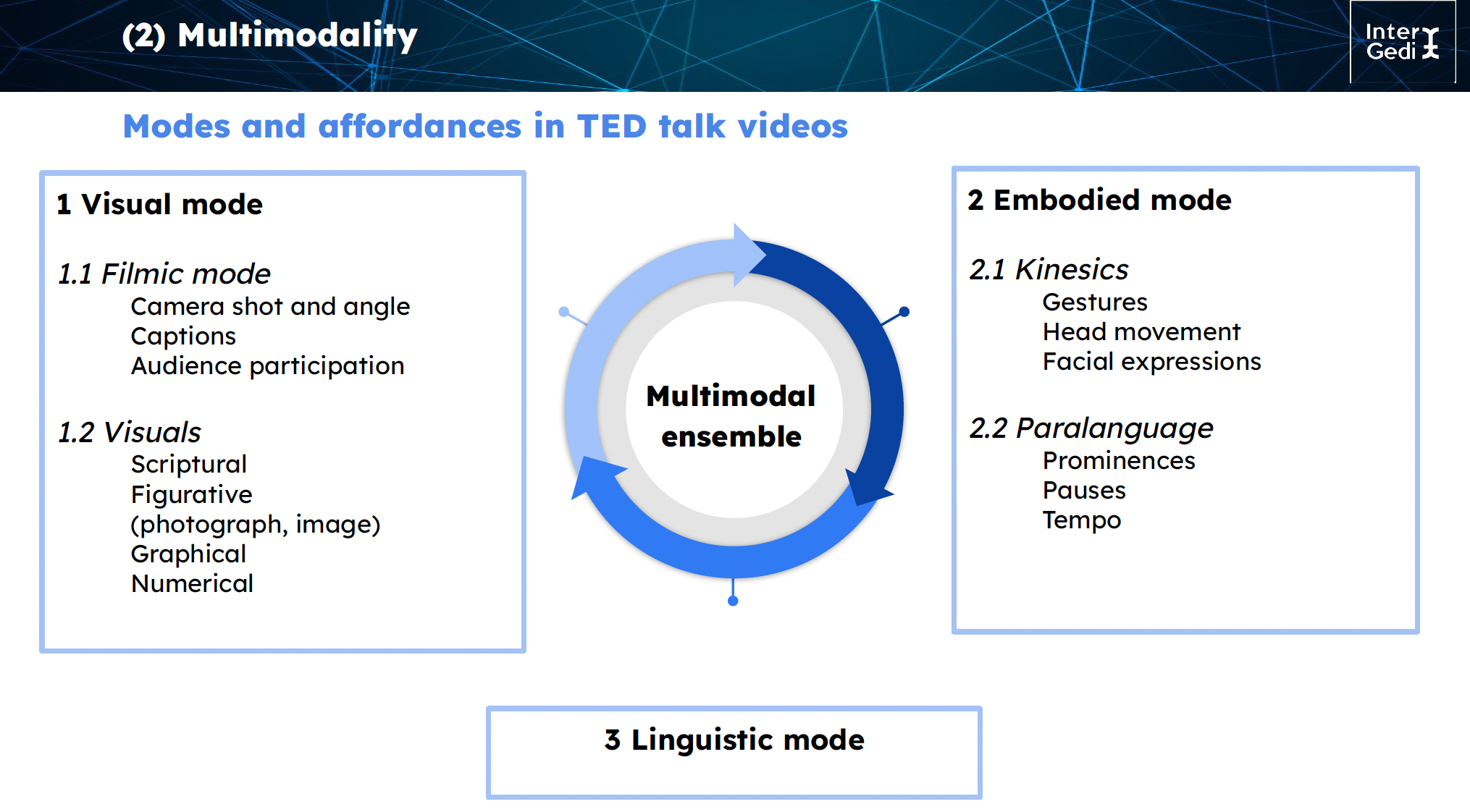
In her talk, “Multimodal resources in TED talk videos”, she shared and discussed a case study of a video themed around autism to examine the meaning making of the orchestrated visual and embodied modes.
You can find the abstract of her presentation below:
Multimodal resources in TED talk videos
Research on scientific popularisation genres has been conducted by numerous scholars (Enberg 2023, Lorés 2025) to elucidate how scientific knowledge is recontextualised for diverse audiences with varying levels of expertise. Popularisation simultaneously aims at the transmission of expert knowledge to non-experts and at “building personal bridges and creating emotional bonds” (Engberg 2023: 166) with audiences. One such digital popularisation genre is the TED talk, which is considered a “digitally mediated video genre” (Xia 2023: 71) consisting of video recorded presentations post-processed by a production team and made accessible through the TED webpage. TED talks constitute a hybrid genre that draws on multiple semiotic resources to communicate scientific knowledge and foster audience engagement. Accordingly, this research adopts the perspective of Multimodal Discourse Analysis (MDA) which argues that all discourse is inherently multimodal (Kress & van Leeuwen 2001), and therefore requires the joint analysis of linguistic and non-linguistic aspects.
The aim of the present study is the identification and analysis of multimodal resources used in TED talks for the recontextualisation of scientific knowledge. This ensemble of semiotic modes includes the linguistic mode in interaction with embodied modes associated with the speaker’s performance, such as kinesic and paralinguistic features, as well as visual modes that encompass the use of slides, including written text and images, and filmic elements of video production, such as type of shot (Bernard-Mechó & Valeiras-Jurado 2023). These resources function both as explanatory strategies that enhance comprehensibility and as engagement strategies that acknowledge and connect with the audience. For this purpose, the study involves a qualitative close analysis of two TED videos, on the topic of Autism Spectrum Disorder. The videos were annotated for linguistic and non-linguistic aspects by means of the ELAN multimodal annotation tool, which allows for synchronised transcriptions and annotations of audio and video data. The study is expected to show how explanatory and engagement strategies in TED talk videos are realised through multimodal choices.
References
Bernad-Mechó, E., & Valeiras-Jurado, J. (2023). Multimodal engagement strategies in science dissemination: A case study of TED Talks and YouTube science videos. Discourse Studies, 25(6), 733–754.
Engberg, J. (2023). Between infotainment and citizen science: Degrees of intended nonexpert participation through knowledge communication. In R. Plo-Alastrué & I. Corona (Eds.), Digital scientific communication: Identity and dissemination (pp. 149–170). Palgrave Macmillan.
Kress, G., & van Leeuwen, T. (2001). Reading images: The grammar of visual design. Taylor & Francis.
Lorés, R. (2025). Discursive interpersonality: Engaging audiences in digital feature articles. Círculo de Lingüística Aplicada a la Comunicación, 103, 257–274.
Xia, S. (2023). Explaining science to the non-specialist online audience: A multimodal genre analysis of TED Talk videos. English for Specific Purposes, 70, 70–85.