
SLTED 2026: Paula Wood-Borque illustrates how to exploit audiovisual input in English as a foreign language teaching
InterGedi member Dr Paula Wood-Borque contributed an oral presentation to the Second Language Teacher Education (SLTED) Conference 2026, hosted by the University of Edinburgh (UK) on September 9th, 10th and11th 2026.
In her paper, titled “Using audiovisual materials in the EFL classroom: From multimodal analysis to teacher training”, Paula addresses the pedagogical potential of audiovisual materials and the role of multimodal analysis in informing EFL teacher education and classroom practice.
Have a look at her abstract here:
Using audiovisual materials in the EFL classroom: From multimodal analysis to teacher training
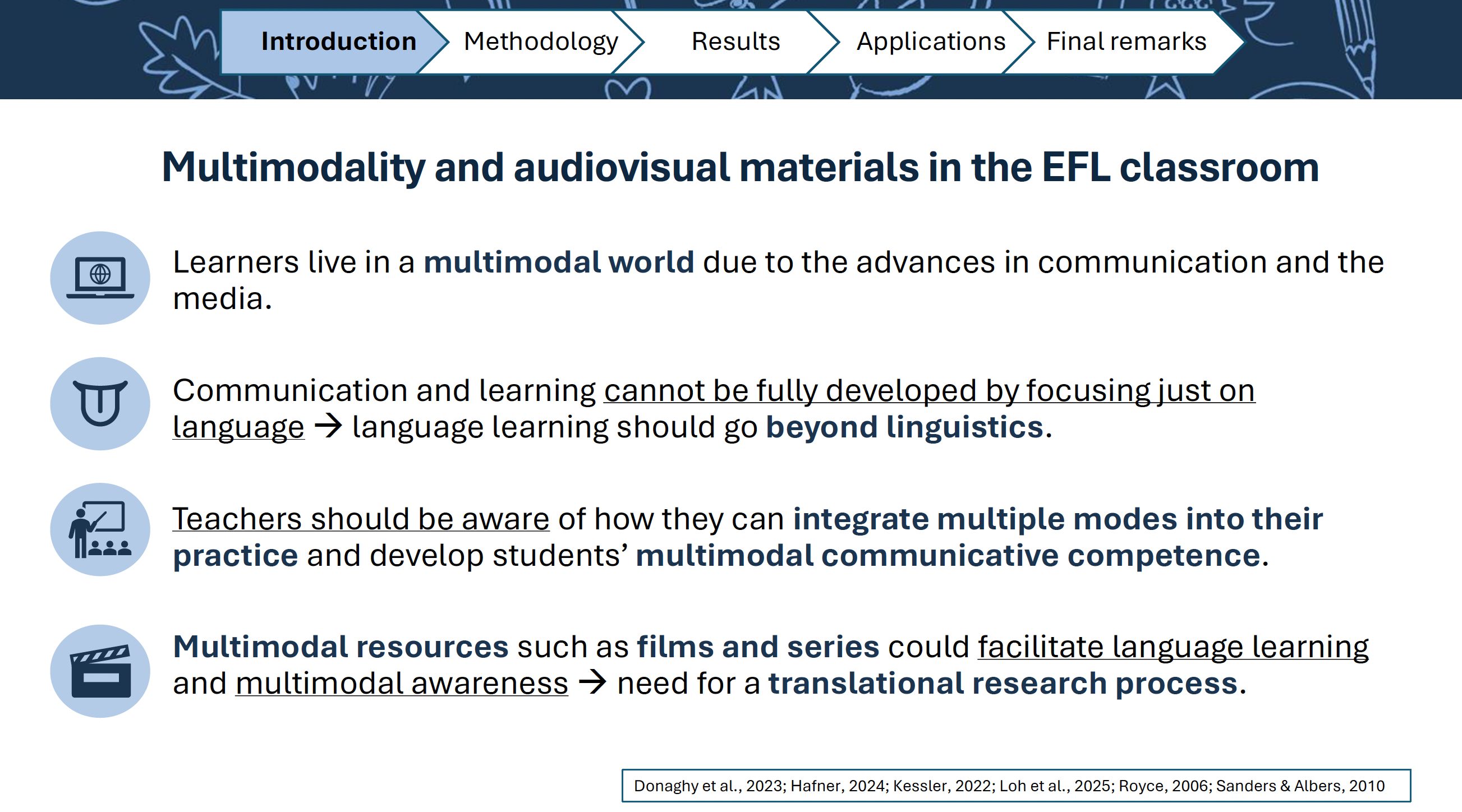
While it is widely recognised that communication has always been intrinsically multimodal, it is growing in complexity due to the rapid technological and media developments. This entails a challenge for foreign language teaching, since communication cannot be fully developed by solely focusing on linguistic features, and therefore teachers must understand how to integrate the teaching of multiple modes into their practice (Hafner, 2024; Kessler, 2022).
International English as a Foreign Language (EFL) curricula, such as the Common European Framework of Reference, highlight the role of multimodality as a key feature in today’s digitally-enhanced communication (Council of Europe, 2020). In this regard, audiovisual materials such as films and series can be effective resources for EFL teaching, not only as sources of authentic language, but also given their rich multimodal nature which can contribute to the development of students’ multimodal communicative competence (Royce, 2006). EFL teachers should understand how to analyse these materials in order to effectively exploit them in the classroom from a multimodal perspective, which may require training.
Thus, this paper will present a proposal of a theoretically-driven analytical model to multimodally analyse the verbal (linguistic) and non-verbal elements (gestures, framing, colour…) of audiovisual materials to contribute to teachers’ (and ultimately students’) understanding of how different modes orchestrate in communication. Specifically, the model was applied to scenes from films and series for EFL teaching. The multimodal analysis results and the pedagogical applications of five scenes from the film Hidden Figures (2016) will be presented in order to illustrate the model’s potential application for teacher training and for EFL classroom use. Given the complexity of applying current frameworks in multimodality to classroom contexts, a translational research process (Loh et al., 2025) was followed to adapt this knowledge and provide tools for teachers to effectively use these materials in the EFL classroom.
References
Council of Europe (2020). Common European Framework of Reference for Languages: Learning, Teaching, Assessment – Companion Volume. Council of Europe Publishing, Strasbourg, available at www.coe.int/lang-cefr
Hafner, C. (2024). Multimodal Discourse Analysis and Second Language Research. In B. Paltridge, & M. T. Prior (Eds), The Routledge Handbook of Second Language Acquisition and Discourse. New York, Routledge. (pp. 24-37).
Kessler, M. (2022). Multimodality. ELT Journal, 76(4), 551-554. https://doi.org/10.1093/elt/ccac028
Loh, C. E., Lim, F. V. & Ow, R. F. L. (2025). Digital Crossings: A Case Study of a Knowledge Mobilisation Approach for Translating Research into Practice. Discourse, Context and Media, 66, 1-12. https://doi.org/10.1016/j.dcm.2025.100910
Royce, T. D. (2006). Multimodal Communicative Competence in Second Language Contexts. In: T. D. Royce & W. Bowcher (Eds.), New Directions in the Analysis of Multimodal Discourse. New York: Rouledge. (pp. 361-390).