
CADS 2026: Paula Wood-Borque and Pilar Mur-Dueñas analyse lexicogrammatical features of filmic discourse for EFL
InterGedi members Dr Paula Wood-Borque and Dr Pilar Mur-Dueñas co-presented at the 8th Corpora and Discourse International Conference (CADS 2026), which was hosted by Lancaster University and took place between the 23rd and the 25th of June 2026.
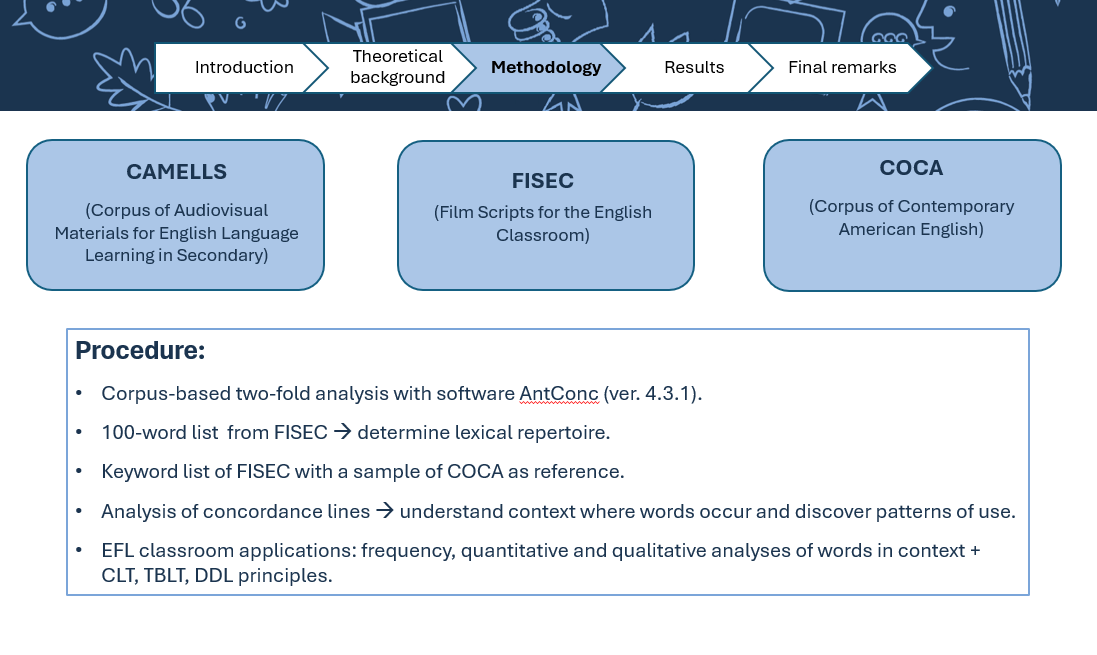
Their paper, “Filmic discourse: From corpus analysis to the English as a Foreign Language classroom”, relied on a corpus-based, twofold analysis of scenes from 19 films, combining keyword and concordancing tools. Based on their lexicogrammatical findings, they discuss how filmic discourse can be leveraged to enhance focus-on-form and focus-on-meaning EFL instruction.
Give a read to their abstract below:
Filmic discourse: From corpus analysis to the English as a Foreign Language classroom
Films offer a rich source of realistic input to be brought into the English as a Foreign Language (EFL) classroom, fostering language skills and communicative competence (e.g. Bednarek, 2018; Donaghy et al., 2023). Notwithstanding the multimodal nature of these audiovisual materials (e.g. Bateman & Schmidt, 2012; Herrero & Vanderschelden, 2024), this paper will focus exclusively on the analysis of the verbal mode of a corpus of films selected for their use in the Secondary Education EFL classroom. It is our aim to analyse filmic discourse based on the scripts of 95 scenes taken from 19 films covering a wide range of genres deemed appropriate for adolescent English L2 viewers. We seek to identify keywords, especially lexical and grammatical features which can help discourse analysts to interpret such scenes, and language educators to make the most of them in the EFL classroom. The analysis is driven by the following research questions: (1) what are the keywords in the scripts from specific film scenes selected to be used in EFL Secondary Education classrooms?; what insights do these keywords offer into the narrative and dialogic construction of meaning in filmic discourse?, (2) what are the most common lexical words?; how can these be related to particular topics which can be brought into the EFL classroom and/or focus on form (vocabulary)?; (3) what are the most common grammatical words?; how can these be related to particular situations and contexts and be targeted in the EFL classroom to focus on form (grammar)?
To answer these questions, a corpus-based two-fold analysis was conducted using the software AntConc 4.3.1 (Anthony, 2024). First, a keyword list of our FISEC corpus (Films Script for the English Classroom), totalling 25,526 words, was generated using as reference corpus a sample of the COCA (Corpus of Contemporary American English). A close look was taken at those words included among the first 50. Concordance analyses were also performed on these keywords to identify their use in context. Second, a 100-word list of the FISEC corpus was created and words classified according to their lexico-grammatical nature, followed by in-depth concordance analyses to derive implications for teaching EFL.
Results from the keyword list point out the dialogic and interactive nature of filmic discourse (e.g. Bednarek, 2018) in different contexts and situations in which the films selected take place – ranging from family reunions to product advertisements and job meetings. In addition, the narrative component of filmic discourse is also reflected in this keyword list, highlighting actions and states. Similar insights are gained from the word list. Concordance lines of the most common and relevant words in the FISEC corpus can help determine if and how the scenes can be brought into the EFL classroom not only for meaning (interpreting the message conveyed) but also for contextualised form-focused instruction (raising awareness on particular lexicogrammatical choices). Overall, the study reveals the usefulness to undertake corpus analysis to make the most of authentic materials to be exploited in the EFL classroom.
References
Anthony, L. (2024). AntConc (Version 4.3.1) [Computer Software]. Tokyo, Japan: Waseda University. https://www.laurenceanthony.net/software/AntConc/
Bateman, J. A. & Schmidt, K.H. (2012). Multimodal film analysis: How films mean. Routledge.
Bednarek, M. (2018). Language and television series: A linguistic approach to TV dialogue. Cambridge Applied Linguistics.
Donaghy, K., Karastathi, S. & Peachey, N. (2023). Multimodality in ELT: Communication skills for today’s generation. Oxford University Press.
Herrero, C. & Vanderschelden, I. (2024). Transmediation: Pedagogical applications of film adaptation in modern Foreign Language Education. In A. Bolaños García-Escribano & M. Oaknín (Eds.). Inclusion, diversity and innovation in translation education (pp. 121153). UCL Press.