
CADS 2026: Rosa Lorés investigates clickbaiting in headlines from digital scientific dissemination texts
InterGedi member Dr Rosa Lorés presented at the 8th Corpora and Discourse International Conference (CADS 2026), held at Lancaster University and celebrated between the 23rd and the 25th of June 2026.
Rosa’s presentation was titled “5 skin cancer-care tools you should look out for”: A pragmalinguistic analysis of clickbaiting practices in digital scientific dissemination”. Through the compilation of a corpus of headlines, her paper investigates and compares the degree and the realisation of clickbaiting strategies across different digital science dissemination practices.
Have a look at her abstract here:
“5 skin cancer-care tools you should look out for”: A pragmalinguistic analysis of clickbaiting practices in digital scientific dissemination
Within the context of digital science dissemination, knowledge brokers are reconsidering the way they “narrate” science, the way they project themselves as credible voices, and the relationship they establish with their audiences. As a result, new practices seem to be emerging to foster reader engagement, one of them being clickbaiting, which is designed to keep readers on the page for as long as possible and is typically associated with sensationalist discourse. Clickbaiting (Bloom and Hansen 2015; Scott 2023) has been widely investigated in online news headline contexts, frequently from a natural language processing approach or from the social perspective of reception studies. However, no research appears to have been conducted so far on digital science dissemination from a discourse-pragmatic, corpus-assisted perspective, as proposed in the present study.
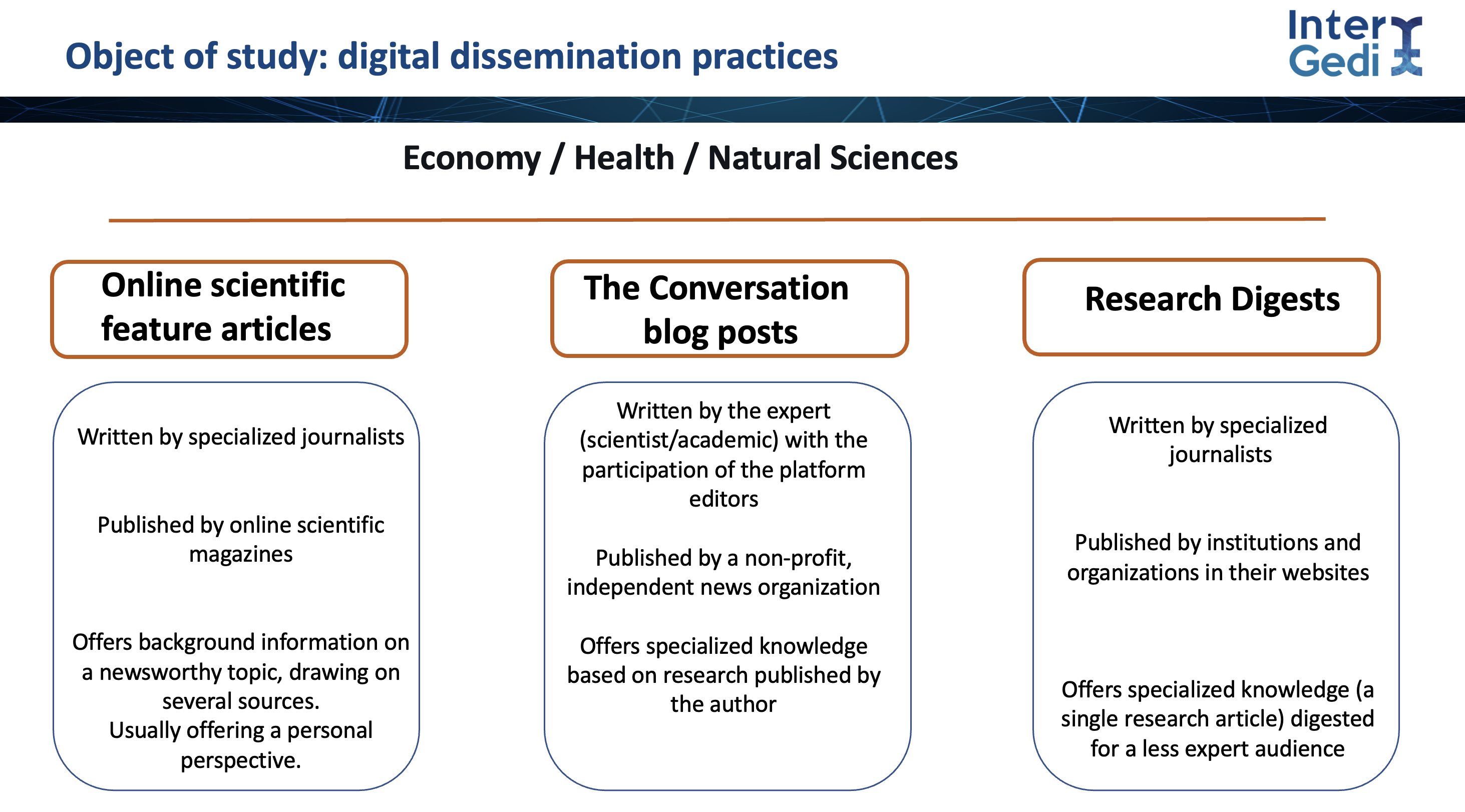
Adopting a CADS approach to the analysis of clickbaiting in digital science dissemination, I constructed a corpus of headlines based on various practices retrieved from the database SciDis (Pascual and Sancho-Ortiz 2024): posts from The Conversation, feature articles from Popular Science and the Smithsonian Magazine and research digests from Science Daily. A collection of 630 headlines on topics related to health, natural sciences, and economy was evenly gathered, and the resulting corpus was subjected to quantitative and qualitative analyses supported by AntConc and NVivo. Two aspects were analysed: (i) headline structure (questions, listicles, the “you won’t believe” pattern, and informative ellipsis (use of suspensive dots or dashes)), and ii) pragmatic markers (deixis (the cataphoric this, and temporal and spatial deixis now and here)), hedging, evaluative language, emotional triggers, and direct appeals to the reader (i.e. directives and personal pronoun you).
Results reveal different degrees of use of clickbaiting tactics in digital science dissemination practices. Research digests, which popularise a single RA, show the lowest presence of these practices, with the use of question structures, high levels of hedging (as in academic discourse), and headlines that become summaries of the content provided in the text. Feature articles display a wider variety of structures, including questions, listicles, a more frequent use of cataphoric deixis (this/ these), and evaluative language, as well as other engagement markers such as the inclusive we. Finally, the platform The Conversation shows the highest presence and the widest range of clickbaiting tactics, including questions, listicles, ellipsis, and emotional triggers.
What can be inferred, then, is that clickbaiting practices occur to varying degrees depending on the type of digital text, and that several factors seem to account for this variation, one of them being the degree to which the digital text depends on the original source. Other practices pertaining to clickbaiting strategies are found to be absent from digital scientific dissemination (i.e., hype and hyperbolic language). This points towards a high level of interdiscursivity, which exploits the blend of discourses (scientific and journalistic / sensationalist) to maximise audience engagement, which might challenge the balance between ethos (credibility) and pathos (appeal to emotions) in digital science dissemination.
References
Blom, J. N, & Hansen, K. R. (2015). Click bait: Forward-reference as lure in online news headlines. Journal of Pragmatics 76, 87–100. https://doi.org/10.1016/j.pragma.2014.11.010
Pascual, D. & Sancho-Ortiz, A. E. (2024). Investigating recontextualisation processes in scientific digital practices: The SciDis Database. Revista Electrónica de Lingüística Aplicada 23, 101-118. https://doi.org/10.58859/rael.v23i1.649
Scott, K. (2023). “‘Deceptive’ clickbait headlines: Relevance, intentions, and lies.” Journal of Pragmatics 218, 71-82. https://doi.org/10.1016/j.pragma.2023.10.004