
The co-edited book by Lorés & Mur-Dueñas is out
The week started off with good news: Lorés & Mur-Dueñas‘s co-edited book, Recontextualizing Expert Knowledge: The Process, Practices and Aims of Digital Dissemination, came out this Monday 23rd March 2026.
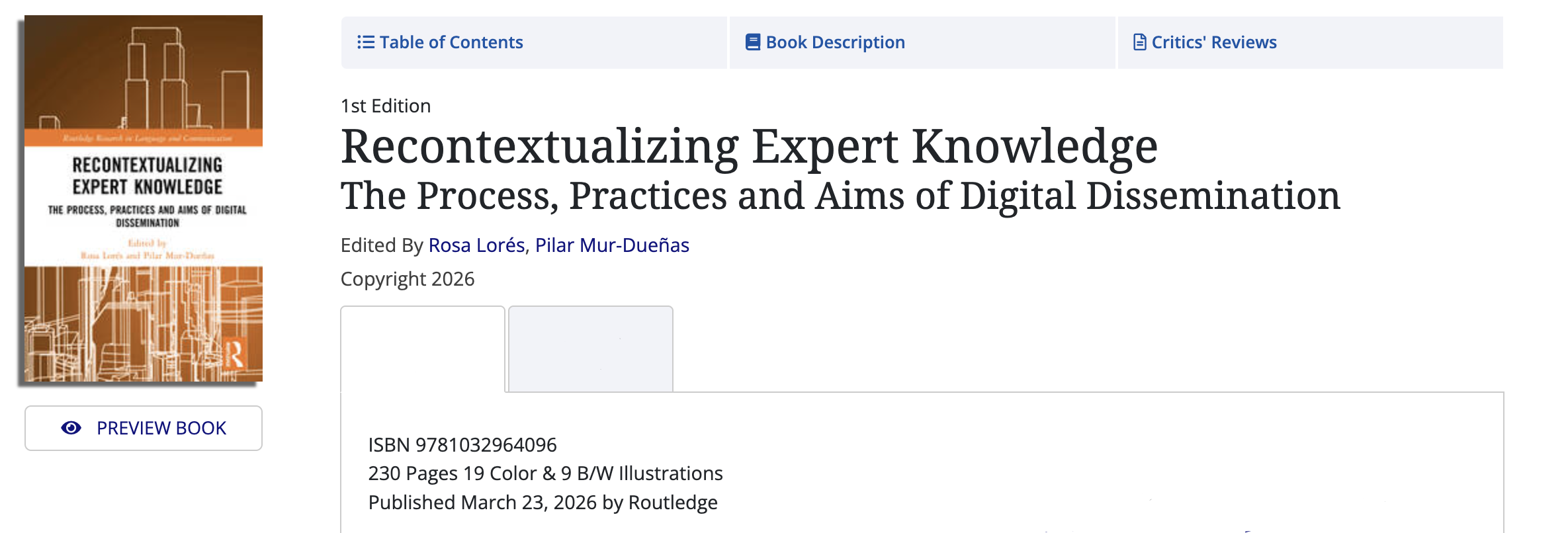
The book, published by Routledge (Taylor & Francis Group), comprises 9 chapters, together with an epilogue and prefaced by an introductory chapter co-authored by InterGedi Principal Investigators Dr Pilar Mur-Dueñas and Dr Rosa Lorés: “Introduction. Sharing knowledge, sharing expertise: recontextualisation in digital dissemination”. The backbone of the manuscript pivots on three broad axes.
The three chapters included in Part 1 focus on Author generated digital recontextualisation: new practices, challenging roles. The first one, co-authored by our InterGedi members Isabel Herrando-Rodrigo and Suganthi John, discusses “The different facets of an academic’s identity: the effects of recontextualization on the identities of writers in The Conversation“. The second chapter, by Wei Wang and Eniko Csomay, focuses on “Recontextualizing science from the university classroom to the TED stage: a metadiscoursal perspective”. Chapter 3, written by co-authors Marina Beccard and Josef Schmied, is titled “Recontextualisation and re-presentation in new science communication genres: metaphorisation strategies in German and English”.
Part 2 of this co-edited book moves on to investigate Mediated digital recontextualisation: transforming knowledge. In this section, Angelicia Anthony Thane and Jean Parkinson co-author a chapter on “Communicating public health knowledge on social media: recontextualisation strategies for Instagram news reporting”. Chapter 5, written by Jordan Batchelor, is titled “Exploring variation within popular science discourse: a corpus-based study of four types of science writing”. The sixth chapter is a contribution by Ruth Breeze analysing “Discursive news values in university press releases”.
In Part 3, papers centre on Reflections on professionals’ disseminating practices: applications and implications. This part consists of two chapters. The eighth one, by Lena Stüdeli and Maria Kuteeva, consists of a study on “Re-catching attention to climate science: recontextualizing research findings in online communication”. Chapter 9 discusses “The challenges of communicating in a sensitive environment about a sensitive topic: the Horizon Europe ARENAS project” and is co-written by Julien Longhi and Katalin Miklóssy. Lastly, Crispin Thurlow authors the epilogue which shares some final food for thought on “Recontextualizing expertise: the art of compromise”.
Many thanks to the co-editors and to all the contributors for the knowledge sharing and production this book engages in. We hope you find it stimulating and thought-provoking!