
VIII LexESP: Irene Puente-Gil analyses metadiscursive and rhetorical patterns in a digital practice for health communication
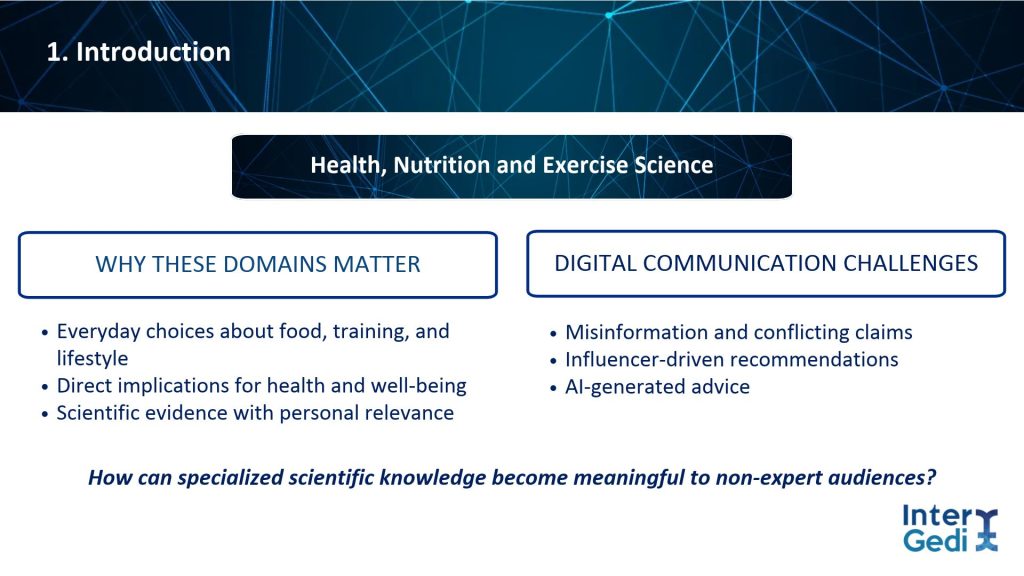
InterGedi member Irene Puente-Gil contributed an individual presentation to the VIII International LexESP Conference on Language and Communication: Nutrition, Healthcare and Well-being, which took place at the Universitat d’Alacant (Spain) on 4-5 November 2026.
In her paper titled “From scientific evidence to actionable knowledge: REPS as a digital health communication practice”, Irene identifies the rhetorical structure and linguistic resources involved in the digital mediation of scientific knowledge in a health communication practice, namely, Research Explained in Practical Summaries (REPS).
Give a read to her abstract below:
From scientific evidence to actionable knowledge: REPS as a digital health communication practice
Digital technologies have reshaped the communication of scientific knowledge. In health-related domains such as nutrition and exercise science, social media, algorithm-driven platforms, and, increasingly, generative AI have expanded public access to scientific information while simultaneously amplifying misinformation and competing health claims. Within today’s attention economy (Hyland, 2023), credibility alone is no longer sufficient (Lorés, 2023). Scientific evidence must also be accessible, engaging, and actionable if it is to reach and support non-expert audiences.
Against this backdrop, this paper examines Research Explained in Practical Summaries (REPS), a digital health communication practice that transforms peer-reviewed nutrition and exercise research into accessible, evidence-based summaries. Rather than merely simplifying scientific articles, REPS strategically recontextualize research through rhetorical and linguistic mediation, combining expert credibility, audience-oriented explanations, and practical recommendations. While individual texts are authored by different contributors acting as knowledge mediators, the practice operates under the umbrella of a recognized expert who functions as a knowledge broker, providing a stable point of reference for credibility while also leveraging an established online community already engaged with evidence-based health information.
The aim of this study is to provide a discursive analysis of a corpus of ten REPS (27,000 words) published in two 2025 issues of the Biolayne monthly research review publication (https://biolayne.com/reps/). A qualitative move analysis (Swales, 2004) is combined with an examination of key metadiscourse features (Hyland, 2005; Mur-Dueñas, 2011) to explore how rhetorical organization and linguistic choices contribute to the mediation of scientific knowledge in this digital practice. The rhetorical analysis shows that REPS constitute a highly conventionalized communication practice that systematically transforms scientific evidence into actionable knowledge. Structurally, information drawn from peer-reviewed research articles is reorganized into a stable rhetorical sequence that guides readers from problem framing to practical application. The linguistic analysis reveals that knowledge mediators resort to distinct metadiscursive resources in each move to balance credibility, comprehensibility, and audience engagement. More broadly, REPS perform recontextualization at structural, epistemic, and communicative levels, selectively foregrounding evidence, redistributing epistemic authority through expert mediation, and reframing research findings as practical guidance. Overall, the findings suggest that REPS exemplify an effective digital health communication practice that integrates credibility, accessibility, and engagement to transform scientific evidence into actionable knowledge in contemporary online environments.
References
Hyland, K. (2023). Academic publishing and the attention economy. Journal of English for Academic Purposes, 64, 101253. https://doi.org/10.1016/j.jeap.2023.101253
Hyland, K. (2005). Metadiscourse: Exploring interaction in writing. Continuum.
Lorés, R. (2023). Dual voices, hybrid identities: The recontextualization of research in digital dissemination scientific discourse. Círculo de Lingüística Aplicada a la Comunicación, 93, 69–84. https://doi.org/10.5209/clac.85566
Mur-Dueñas, P. (2011). An intercultural analysis of metadiscourse features in research articles written in English and in Spanish. Journal of Pragmatics, 43(12), 3068–3079. https://doi.org/10.1016/j.pragma.2011.05.002
Swales, J. M. (2004). Research genres: Explorations and applications (2nd ed.). Cambridge University Press.