
SLTED 2026: Luis Martínez-Kleiser puts forward a proposal to develop multimodal literacy in EFL/CLIL settings
InterGedi member Luis Martínez-Kleiser presented at the Second Language Teacher Education (SLTED) Conference 2026, which took place at the University of Edinburgh (UK) between September 9-11th 2026.
The title of his paper was “Using adolescent-targeted science dissemination texts to develop multimodal literacy in the secondary education EFL/CLIL classroom”. His contribution explored the potential of science dissemination texts aimed at adolescents as resources for enhancing multimodal literacy in secondary education EFL/CLIL contexts.
You can give a read to his abstract below:
Using adolescent-targeted science dissemination texts to develop multimodal literacy in the secondary education EFL/CLIL classroom
In today’s world, it is not feasible to understand language and its uses without considering the impact of all present-day modes of communication (Kress, 2000). The multimodal nature of communication needs to be embraced in the EFL to provide students with the competencies to communicate effectively (Hafner, 2024).
The Internet has enabled easy access to scientific knowledge for diverse audiences, including adolescents. They seek information on topics of interest, such as climate change and mental and physical health, to satisfy a curiosity that can be useful in EFL secondary classrooms. Using virtual realia creates motivating and meaningful learning experiences that enhance linguistic and cultural comprehensibility (Smith, 1997), which are fundamental for the EFL and CLIL classroom. How real digital scientific recontextualised texts not adapted for language teaching can be employed in class to develop multimodal literacy and communicative competence in adolescents deserves attention.
SciDisTA corpus (Scientific Dissemination Texts for Adolescents) was compiled to conduct a multimodal analysis of how visual elements are used to portray credibility, comprehensibility and engagement (Lorés, 2023) in adolescent-targeted digital scientific texts. It consists of 30 texts from three different websites and is part of the SciDis database compiled by the InterGEDI Research Group (Pascual & Sancho-Ortiz, 2024). Photographs, drawings, graphics, tables, logos, diagrams and tables were analysed, considering their role, position, function and relationship with the text using NVivo 14 software.
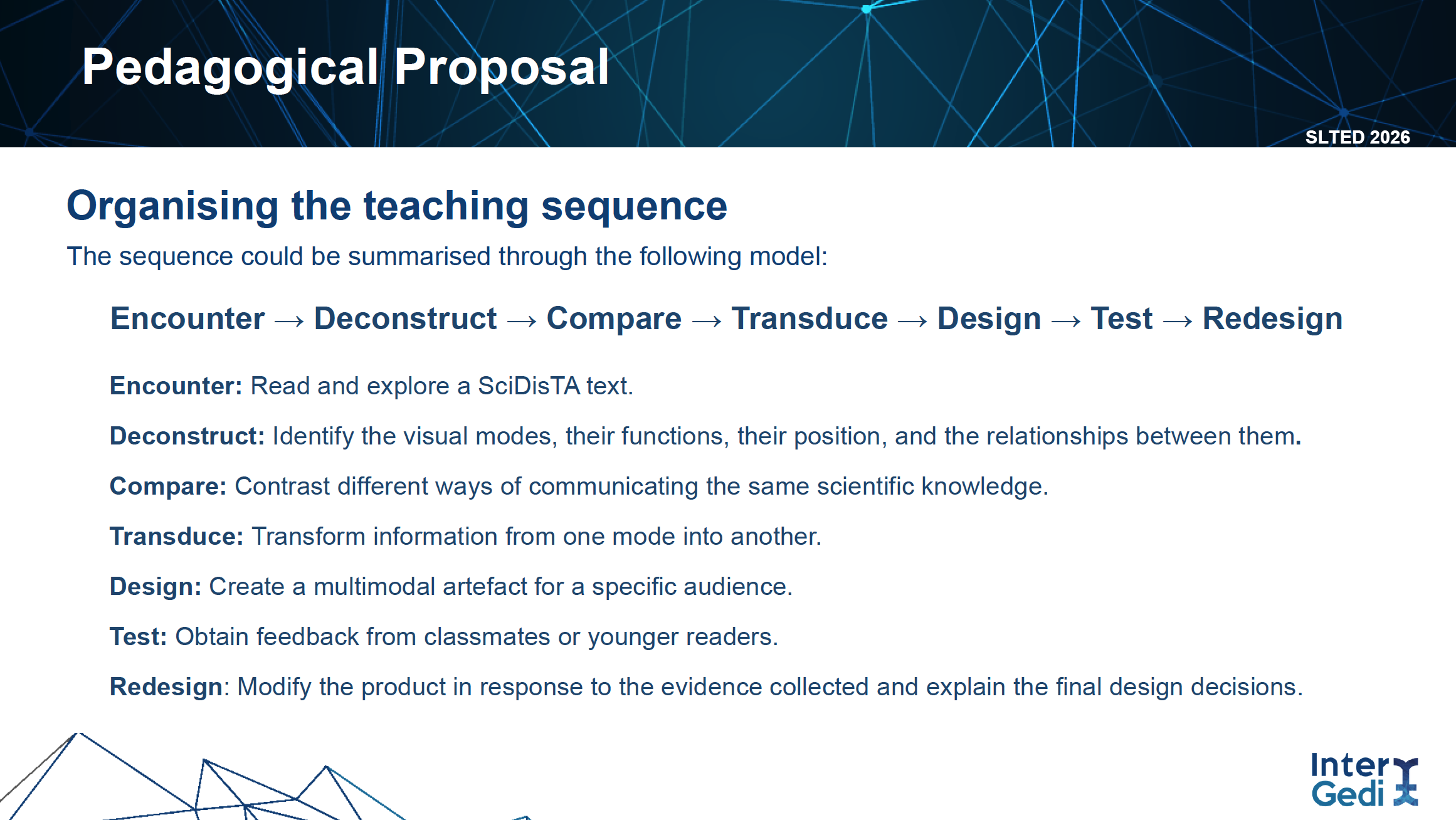
The results of the analysis allow for the presentation of a classroom exploitation model to improve secondary students’ multimodal communication and communicative competence. Through learning situations, the use of design principles to develop multiliteracies (Lim, 2023), educators will be empowered to teach EFL secondary students to create their own effective multimodal artefacts to disseminate science to peers and younger learners. In addition, this proposal can boost the impact of CLIL methodology in science classrooms.
References
Hafner, C. (2024). Multimodal discourse analysis and second language research. In B. Paltridge & M. T. Prior (Eds.), The Routledge handbook of second language acquisition and discourse (pp. 24–37). Routledge. https://doi.org/10.4324/9781003177579-4
Kress, G. (2000). Multimodality: Challenges to thinking about language. TESOL Quarterly, 34(2), 337–340. https://doi.org/10.2307/3587959
Lim, F. V. (2023). A design-based research approach to the teaching and learning of multiliteracies. Asia-Pacific Education Researcher, 32(5), 641-653. https://doi.org/10.1007/s40299-022-00683-0
Lorés, R. (2023). Dual voices, hybrid identities: The recontextualization of research in digital dissemination scientific discourse. Círculo de Lingüística Aplicada a la Comunicación, 93, 69–84. https://doi.org/10.5209/clac.85566
Pascual, D., & Sancho-Ortiz, A. E. (2024). Investigating recontextualisation processes in scientific digital practices: The SciDis Database. Revista Electrónica de Lingüística Aplicada, 23(1). https://doi.org/10.58859/rael.v23i1.649
Smith, B. (1997). Virtual realia. Internet TESL Journal, 3(7), 1-5.