
AESLA 2026: Rosa Lorés analyses audience-oriented pragmatic strategies vis-à-vis discursive interpersonality
InterGedi researcher Rosa Lorés delivered a paper at the 43º Congreso Internacional de la Asociación Española de Lingüística Aplicada (AESLA). Under the motto of “Lengua, variación e identidad: dinámicas lingüísticas para representar la sociedad“, the conference was celebrated between April 15th and 17th 2026 and was hosted at the University of Granada.
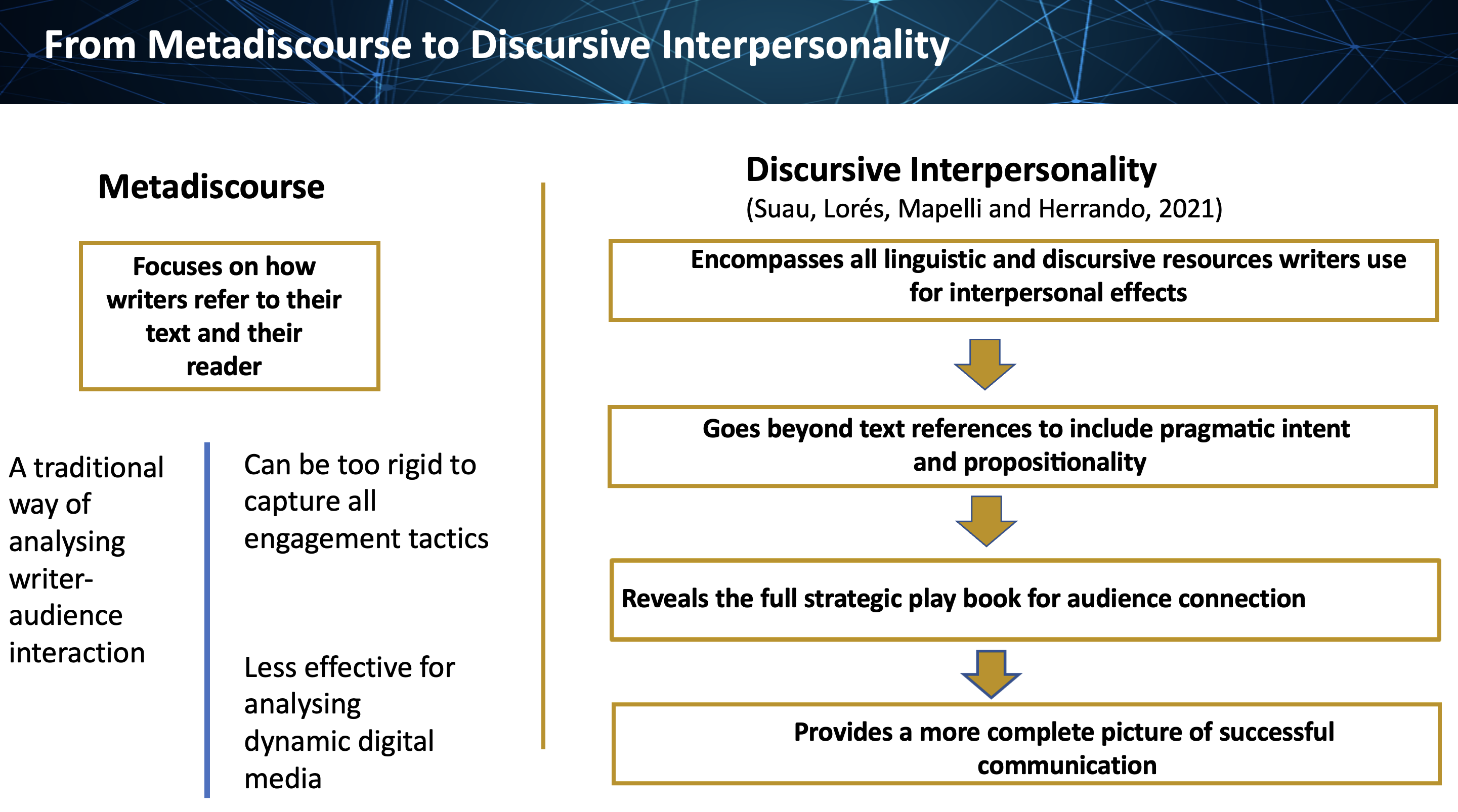
Rosa’s presentation was titled “Beyond metadiscourse: Discursive interpersonality and audience engagement in digital science communication”. In her paper, she explores how science knowledge is pragmatically articulated through the conceptual lens of discursive interpersonality in digital health-related feature articles.
Learn more by reading her abstract below:
Beyond metadiscourse: Discursive interpersonality and audience engagement in digital science communication
The traditional divide between scientists and the public has been questioned for decades now (Jones et al., 2015; Pascual, Plo-Alastrué and Corona, 2023), given the existence of diverse audiences that display varying levels of understanding, knowledge, interest, and needs. Readers are now seen as active participants in the overall societal conversation about science. In this view, the aim of science communication is not only to explain scientific findings but also to interpret and clarify their societal significance, thereby advancing the democratization of access to expert knowledge. When it comes to making science more accessible to the public, engaging audiences is widely regarded as essential for science communicators aiming to bridge the gap between the expert knowledge they convey and their target audience’s presumed lack of expertise.
Drawing on the concept of discursive interpersonality (Suau et al., 2021), this study explores a corpus of 30 digital feature articles on mental and physical health topics written by professional science journalists and included in the SciDis Corpus (Pascual and Sancho-Ortiz, 2024). The study aims to identify and examine the pragmatic strategies and their associated (meta)discursive features through which science communicators manage to make complex expert knowledge accessible and engaging for untrained audiences.
Using the NVivo software for qualitative analysis, the study identifies four primary pragmatic strategies to foster audience engagement: i) hooking the audience’s attention; ii) creating an emotional bond with the audience; iii) enhancing direct interaction with the audience; and iv) establishing a common territory of experience. The results of this study underscore the fact that these audience-oriented strategies extend beyond what has been conceived as conventional metadiscoursal uses, leveraging resources adapted from journalistic and narrative discourses. Discursive interpersonality thus accounts for the wide variety of features—combining pragmatic, discursive, multimodal, and lexicogrammatical levels—that motivate and facilitate audiences’ access to knowledge. Conclusions indicate that while a core set of engaging features is common to the genre, editorial and disciplinary differences influence the specific frequency and variety of resources employed.
References
Jones, R. J., Chick, A., & Hafner, C. (2015). Introduction: Discourse analysis and digital practices. In R. H. Jones, A. Chik, & C. Hafner (Eds.), Discourse and digital practices: Doing discourse analysis in the digital age (pp. 1-17). Routledge. https://doi.org/10.4324/9781315726465
Pascual, D. & Sancho-Ortiz, A.E. (2024). Investigating recontextualisation processes in scientific digital practices: The SciDis Database. Revista Electrónica de Lingüística Aplicada, 23, 101 118. https://doi.org/10.58859/rael.v23i1.649
Pascual, D., Plo-Alastrué, R. & Corona, I. (2023) Digital scholarly practices in scientific communication: Paths and goals in research dissemination. In R. Plo-Alastrué & I. Corona (Eds.), Digital scientific communication: Identity and visibility in research dissemination (pp. 3-30). Palgrave Macmillan. https://doi.org/10.1007/978-3-031-38207- 9_1
QSR International. (2023). NVivo (Version 14) [Computer software]. https://www.qsrinternational.com/nvivo-qualitative-data-analysis-software
Suau-Jiménez, F., Lorés, R., Mapelli, G. & Herrando-Rodrigo, I. (2021). La interpersonalidad discursiva como alternativa al metadiscurso interpersonal. Onomázein, 54, 113–141.https://doi.org/10.7764/onomazein.54.07