
CADS 2026: Daniel Pascual analyses explanatory processes in Ask-an-Expert websites across disciplines
InterGedi member Dr Daniel Pascual presented at the 8th Corpora and Discourse International Conference (CADS 2026), which was celebrated at Lancaster University from June 23rd to June 25th 2026.
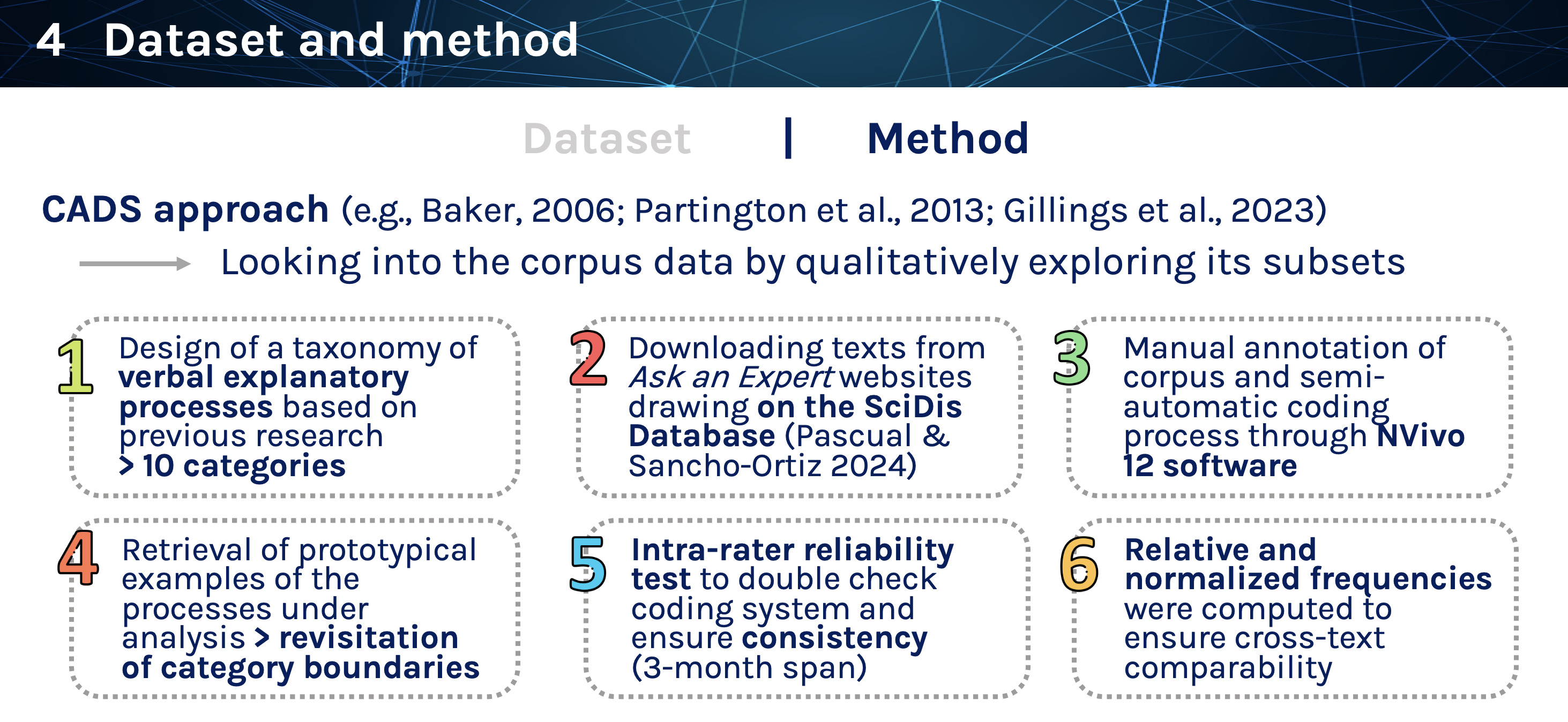
His paper was titled “Explanatory processes in expert discourse: A view on Ask-an-Expert websites across disciplinary fields”. There, he analysed a corpus of digital texts featuring psychology, nutrition and climate expert discourse and observed patterned uses and disciplinary differences regarding the deployment of explanatory processes.
You can read his abstract below:
Explanatory processes in expert discourse: A view on Ask-an-Expert websites across disciplinary fields
Scientific knowledge is increasingly available to the wider public thanks to digital media. Careful efforts are made by experts to unpack their disciplinary fields and disclose complex topics that are socially relevant. The recontextualisation of expert discourse is key in this process, so that interaction between experts and diverse audiences may result in “communicative efficiency” (Roelcke 2002). The present study focuses on Ask-an-Expert websites as a digital practice where users pose questions answers by accredited professionals who aim to foster intelligibility, credibility, and trust. Relying on the SciDis Database, which compiles representative examples of scientific dissemination practices (Pascual and SanchoOrtiz, 2024), three disciplinary fields are chosen to explore how potential “knowledge asymmetries” (Kastberg 2011) regarding expert discourse are bridged: nutrition, psychology, and climate. The corpus comprises two specific websites per field, and 25 texts per website, totalling 150 Ask-an-Expert texts. The main goal of this paper is to investigate the verbal explanatory processes through which expert discourse is adapted to accommodate lay users on these websites. The analysis follows a Corpus-Assisted Discourse Studies (CADS) approach, and presents a mixed-method design. Drawing on previous research (e.g., Cavalieri and Diani 2019; Mur-Dueñas 2024), the close exploration of the corpus led to the design of a taxonomy of ten salient explanatory processes: elaboration, explicitation, definition, denomination, enumeration, exemplification, justification, attribution, metaphor and comparison/analogy. The corpus was coded using the NVivo software. The frequency of use of these processes was retrieved to establish a comparison across disciplinary fields.
Results reveal shared communicative patterns and disciplinary differences in how experts tailor explanations for lay audiences. Across all six Ask-an-Expert sites, explicitation, exemplification, elaboration, and definition are central to catering for users’ knowledge gaps and recontextualizing specialised discourse. Explicitation and exemplification are particularly frequent, clarifying technical content and using concrete scenarios. Definition and elaboration are recurrently used to unpack terminology and expand initial answers. Clear discipline-specific profiles emerge as well. Ask-an-Expert texts on dietetics and nutrition emphasise practical justification and enumeration, reflecting the applied, action-oriented nature of nutritional guidance. Psychology and mental health sites rely more on metaphor, and analogy to contextualise emotional or behavioural issues, grounding advice in psychological theory and relatable experiences. Climate and environmental platforms favour exemplification and comparison with everyday processes to make complex scientific mechanisms more tangible. Overall, insights into verbal explanatory processes can help scientists and researchers facilitate disciplinary knowledge and conceptual complexity to the wide public, while bolstering credibility and trust in dialogic ways that contribute to making science accessible and comprehensible.
References
Cavalieri, S. & Diani, G. (2019). Exploring health literacy. Web-based genres in disseminating specialized knowledge to caregivers. The case of paediatric neurological disorders. Lingue Culture Mediazioni/ Languages Cultures Mediation, 6(1), 89-105. https://doi.org/10.7358/lcm-2019-001-cadi
Kastberg, Peter (2011). Knowledge asymmetries: Beyond “to have and have not”. Fachsprache: International Journal of Specialized Communication, 34(3-4), 137-151.
Mur-Dueñas, P. (2024). Digital dissemination practices: An analysis of explanatory strategies in the process of recontextualising specialised knowledge. Discourse and Interaction, 17(1), 94–114. https://doi.org/10.5817/DI2024-1-94
Pascual, D. & Sancho-Ortiz, A. E. (2024). Investigating recontextualisation processes in scientific digital practices: The SciDis Database. Revista Electrónica de Lingüística Aplicada 23, 101-118. https://doi.org/10.58859/rael.v23i1.649
Roelcke, T. (2002). Efficiency of communication: A new concept of language economy. Glottometrics 4, 27–38.