
CILC 2026: Isabel Herrando-Rodrigo dissects credibility construction through a close corpus analysis of health-related digital texts
InterGedi member Dr Isabel Herrando-Rodrigo contributed a paper to the 17th International Conference on Corpus Linguistics (CILC 2026), celebrated between June 10th-12th 2026. The conference was held at the Autonomous University of Madrid (Spain) and was organised by the Computational Linguistics Laboratory (LLI-UAM) of the Department of General Linguistics and Modern Languages of the Faculty of Philosophy and Letters. The theme of this CILC edition looked into the “Origins, present and perspectives of corpus linguistics”.
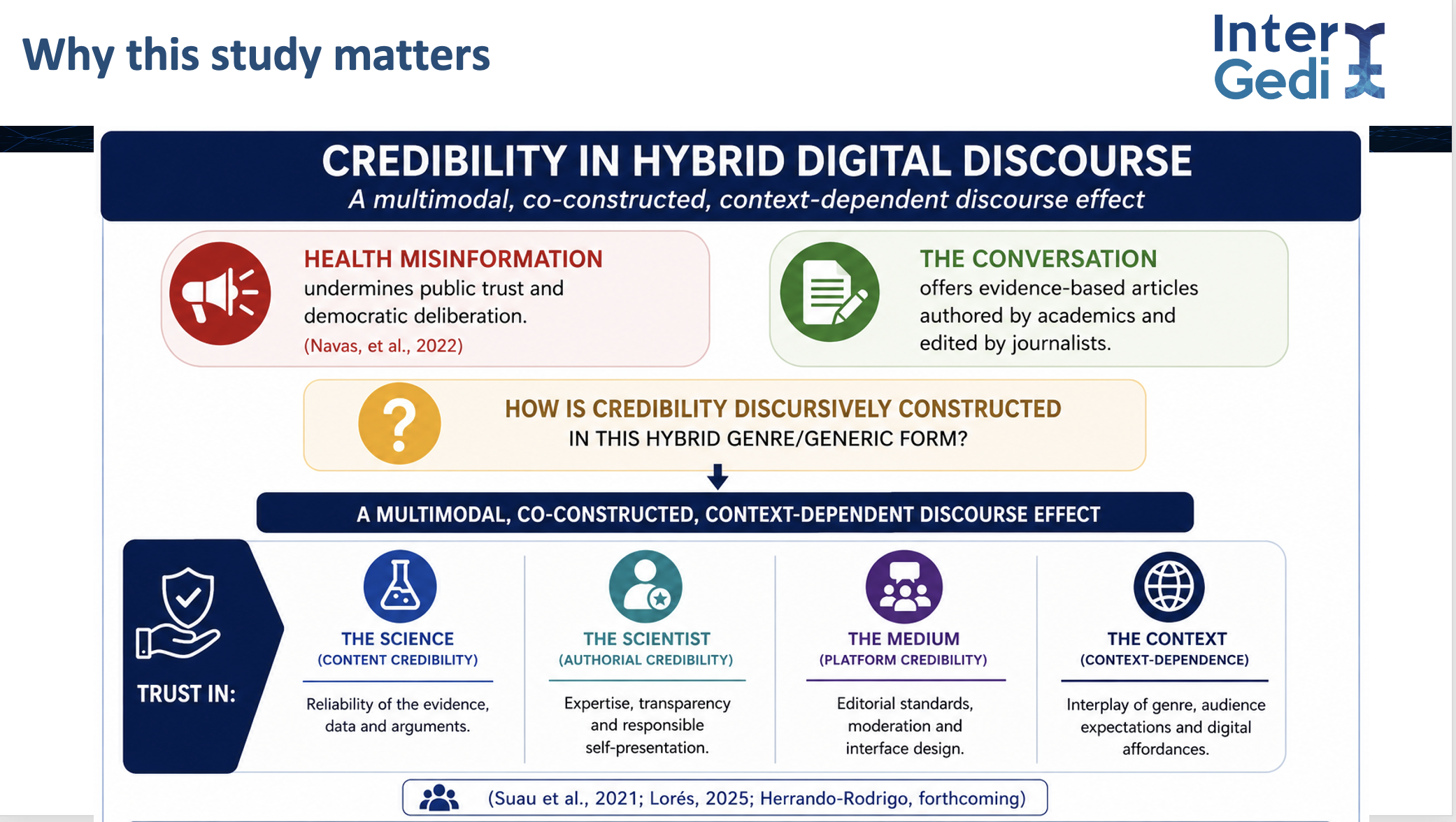
In her paper titled “Corpus Linguistics in the Age of AI: Rethinking Credibility through Close Analysis of Small Digital Corpora”, Isabel underscores and illustrates the lasting value of corpus linguistics approaches in an era marked by AI-assisted text production and interpretation. Through an exploratory close analysis of a health-related corpus, her paper draws on the framework of discursive interpersonality to throw light on elements that are orchestrated to discursively construct credibility in digital settings.
Have a look at her abstract below:
Corpus Linguistics in the Age of AI: Rethinking Credibility through Close Analysis of Small Digital Corpora
In an era increasingly shaped by Artificial Intelligence (AI), where textual production and interpretation are often delegated to automated systems, this paper argues that Corpus Linguistics remains indispensable. Its enduring value lies not only in identifying recurring linguistic patterns, but also in providing the interpretive framework needed to explain how meaning is constructed in context, particularly in socially sensitive communicative settings (Carrió-Pastor, 2020). In this sense, small, carefully designed corpora continue to offer an essential complement to large-scale computational approaches.
To support this argument, the paper presents an exploratory study based on a manually annotated corpus of ten health-related articles from The Conversation (12,626 words). Drawing on the framework of Discursive Interpersonality (Suau-Jiménez, 2016; Suau-Jiménez et al., 2021; Lorés, 2025), the analysis examines engagement markers, self-mentions, hyperlinking practices, and paratextual features such as author profiles, layout, and comment sections. The findings show that credibility is discursively co-constructed through the interaction of academic authorship, editorial mediation, and platform affordances.
In a landscape increasingly threatened by disinformation and algorithmic opacity, this contribution calls for a revalorisation of small-scale, human-centred corpus approaches. It positions close corpus analysis as a necessary counterbalance to decontextualised datafication, allowing researchers to trace how meaning and credibility are constructed in digital discourse. The study ultimately defends corpus linguistics as a discipline not only compatible with AI, but essential for interpreting the discursive complexity that AI tools cannot fully capture—particularly in hybrid genres where language, trust, and social vulnerability intersect (Winkel, 2025).
References
Carrió-Pastor, M.L (Ed.). (2020). Corpus analysis in different genres: Academic discourse and learner corpora. Routledge.
Herrando-Rodrigo, I.& J., Suganthi. (2026). The different facets of an academic’s identity The effects of recontextualization on the identities of writers in The Conversation. In R. Lorés & P. Mur-Dueñas (Eds.) Recontextualizing Expert Knowledge: The Process Practices and Aims of Digital Dissemination. Routledge.
Lorés, R. (2025). Discursive Interpersonality: Engaging Audiences in Digital Feature Articles. Círculo de Lingüística Aplicada a la Comunicación, 103, 199-274. https://dx.doi.org/10.5209/clac.101048
Suau-Jiménez, F.. (2016). What can the discursive construction of stance and engagement voices in traveler forums and tourism promotional websites bring to a cultural, cross-generic and disciplinary view of interpersonality?, Ibérica, 31, 199-220.
Suau-Jiménez, F., Lorés-Sanz, R., Mapelli, G., & Herrando-Rodrigo, I. (2021). La interpersonalidad discursiva como alternativa al metadiscurso interpersonal. Onomázein, 54, 113-141. https://doi.org/10.7764/onomazein.54.07
Winkel, Marek. (2025). Society in charge: the connection of artificial intelligence, responsibility, and ethics in German media discourse. AI Ethics, 5, 2839–2866 https://doi.org/10.1007/s43681-024-00604-5