
EPICS XII: Ana E. Sancho-Ortiz explores expert identity through a pragmatic-multimodal lens
InterGedi member Ana Eugenia Sancho-Ortiz participated in the Twelfth International Symposium on Intercultural, Cognitive and Social Pragmatics (EPICS XII). The theme of this year’s edition was “Discourse pathologisation in Twitter, Instagram and TikTok” and took place at Pablo de Olavide University (Seville, Spain), between May 27th and 29th 2026.
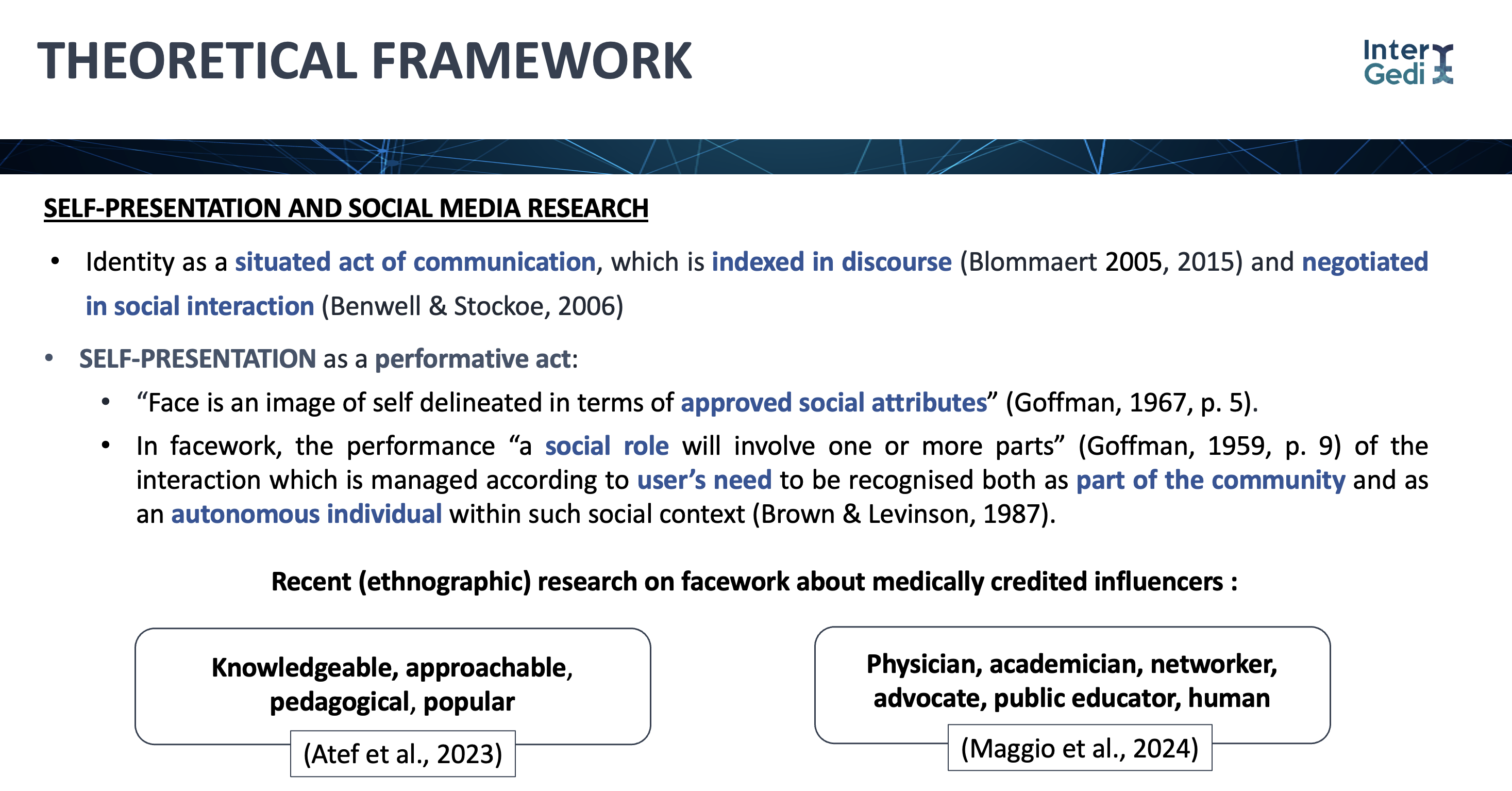
Ana’s presentation was titled as follows “Sharing knowledge or selling the knowledge-holder? A pragmatic and multimodal exploration of expert identity on Instagram through the analysis of post design”. She discussed the interplay of a curated influencer persona and the deployment of semiotic composition in crafting informative and instructional health-related posts.
To find out more, read her abstract below:
Sharing knowledge or selling the knowledge-holder? A pragmatic and multimodal exploration of expert identity on Instagram through the analysis of post design
Social media (SM) are broadly recognised for their potential as “tools for shaping identity” (Van Dijk, 2013, p.213), with users leveraging their multimedia affordances for self-performance (Papacharissi, 2002). Within SM health communication, self-presentation topics such as credibility and self-branding are recurrently considered in connection with the figure of wellness
influencers (e.g.,Durau et al., 2022; Wellman, 2023), i.e., lay users whose social recognition relates to their self-transformation, lifestyle narratives (Baker & Rojek, 2020). Nonetheless, the self-presentation dynamics of wellness influencers who are not lay users but are fully medically trained professionals remain widely underexplored (O’Neil, 2025).
This proposal therefore approaches expert identity on Instagram focusing on professionally credited physiotherapy experts. It explores the connection between the adoption of an influencer-like curated style and the semiotic composition of informative and instructional posts. Specifically, 100 posts from two physiotherapists (50/user) are pragmatically and multimodally analysed drawing on Brown & Levinson’s (1987) dualistic approach to “face” in combination with Kress & Van Leeuwen ([1996,2006]2021) and Van Leeuwen’s (2022) respective approaches to functional- and identity-design. Post design is particularly examined through the study of visual
resources (overlaid images, iconographic elements, typography and colour) and verbal resources (self-mentions, reader addresses and imperatives).
Preliminary results indicate an enactment of a self-branded persona that coexists with the experts’ identities as knowledge holders and instructors. This is perceived in the stylistically homogeneous design of posts given the systematic alternation of font types and background colour for informative and self-promotional content, the insertion of username-based logos and the strategic use of audience addresses to portray them as consumers of experts’ services. Findings also suggest an idiosyncratic distinctiveness in experts’ branded identities, especially in the selective use of images. Whilst one user ironically employs naturalistic photographs to frame his view of specialised topics, the other predominantly shares self-portraits alongside audience-oriented appeals to purchasing his products. Altogether, this study about qualified users uncovers emerging, hybridised expert identities defined by the calculated uptake of knowledge-sharing and self-commodification practices in post design.
References
Baker, S. A. & Rojek, C. (2020). Lifestyle gurus: Constructing authority and influence online. Polity Press.
Brown, P. and Levinson, S. C. (1987). Politeness: Some universals in language usage. Cambridge University Press. https://doi.org/10.1017/CBO9780511813085
Durau, J., Diehl, S., & Terlutter, R. (2022). Motivate me to exercise with you: The effects of social media fitness influencers on users’ intentions to engage in physical activity and the role of user gender. Digital Health, 8. https://doi.org/10.1177/20552076221102769
Kress, G. and van Leeuwen, T. ([1996,2006]2021). Reading Images: The Grammar of Visual Design. Routledge. https://doi.org/10.4324/9781003099857
O’Neill, R. (2025). Rethinking the ‘wellness influencer’: Medical doctors, lifestyle expertise and the question of credentials. International Journal of Cultural Studies, 28(3), 685-701. https://doi.org/10.1177/13678779241307032
Papacharissi, Z. (2002). The Self Online: The Utility of Personal Home Pages. Journal of Broadcasting & Electronic Media, 46(3), 346-368.
Van Dijck, J. (2013). ‘You have one identity’: Performing the self on Facebook and LinkedIn. Media, culture & society, 35(2), 199-215.
Van Leeuwen, T. (2022). Multimodality and identity. Routledge.
Wellman, M. L. (2023). “A friend who knows what they’re talking about”: Extending source credibility theory to analyze the wellness influencer industry on Instagram. New Media & Society, 26(12), 7020-7036. https://doi.org/10.1177/14614448231162064