
AESLA 2026: Ana E. Sancho-Ortiz looks into interactional markers in macro-influencers’ expert discourse
Our InterGedi member Ana Eugenia Sancho-Ortiz presented at the 43º Congreso Internacional de la Asociación Española de Lingüística Aplicada (AESLA). This year’s conference, targeting “Lengua, variación e identidad: dinámicas lingüísticas para representar la sociedad“, was celebrated at the University of Granada, from April 15th to April 17th 2026.
In her paper titled “Projecting expertise on Instagram: Interactional discursive mechanisms by physiotherapy macro-influencers”, Ana adopts a pragmalinguistic approach to discuss the effects of interactional discursive cues used on 100 Instagram posts from two physiotherapists’ accounts.
You can read her abstract below:
Projecting expertise on Instagram: Interactional discursive mechanisms by physiotherapy macro-influencers
Social media (SM) are widely considered in healthcare communication for their effectivity to facilitate expert to non-expert interaction and make specialised knowledge accessible to diversified audiences (Chen & Wang,2021). Besides, their ever-increasing identity shaping affordances (van Dijck, 2013) have meant the consolidation of digital identity and citizenship “as key facet of [the] professional responsibility” (Ruan et al., 2020,p.8) of healthcare professionals, especially in the era of wellness influencers (Baker, 2022). Consequently, research has recently begun to consider the intersection between expertise and (wellness) influencer discourses through self-presentation theory (Goffman, 1959), focusing primarily on SM professionals within general medicine (Atef et al., 2023; Maggio et al., 2024).
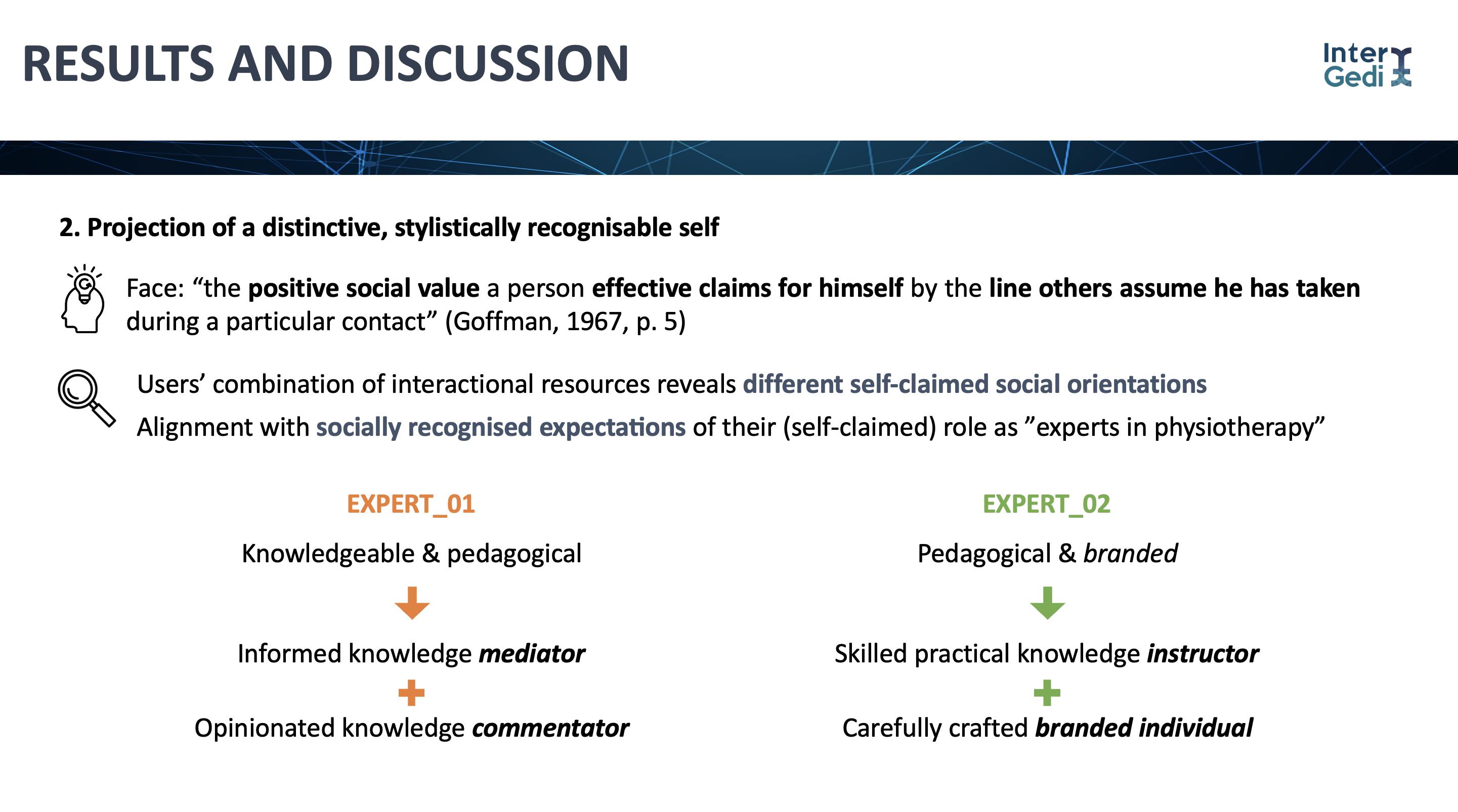
To contribute to this field, this proposal examines expert identity on Instagram concentrating on physiotherapy professionals who qualify as macro-influencers (Campbell and Farren, 2020). Drawing on Goffman’s (1967) notion of face-work, a data-driven pragmalinguistic exploration of 100 posts by two physiotherapists (50 posts each) is carried out. Acknowledging the interpersonal and discursive character of identity, this study operationalises expert self-presentation from a metadiscursive perspective, particularly investigating the use of interactional resources (Hyland, 2005) in the textual content of posts’ visual and caption. Thus, mixed-method research is conducted on the employment of attitude markers (stance adverbs and evaluative adjectives), self-mentions (first person pronouns and tags), engagement markers (audience addresses, imperatives, and rhetorical questions), boosters (exclamative forms) and hedges (modal verbs and adverbial and adjectival phrasing).
Preliminary results suggest that these professionals construct their audience as lay knowledge receivers, reinforcing their performance of a “knowledgeable specialist” face. This is evidenced by the combination of dialogic resources (direct addresses and rhetorical questions) with high-epistemic boosting devices (superlative forms and stance adverbs), which signal a knowledge gap between experts and their public and enhance experts’ role as essential information sources. Findings also indicate users’ enactment of distinctive hybridised expert identities given their idiosyncratic use of interactional resources. Notably, one user extensively relies on first-person singular pronouns, categorical stance adverbs and vulgar language to frame his opinion on disciplinary topics and distinguish himself as a “knowledge-mediator” on Instagram. The other foregrounds a “pedagogical”, “self-branded” persona, introducing imperatives and direct addresses to instruct on exercise performance and prompt consumption of his training products. In all, this pragmatic study on interpersonal metadiscourse features for expert self-presentation on Instagram hints at the emergence of new constructs of (digital) expertise that transcend knowledge-holder identities to embrace the self-branding rhetoric of self-differentiation permeating social media discourses.
References
Atef, N., Fleerackers, A., Alperin, J.P. (2023). “Influencers” or “Doctors”? Physicians’ Presentation of Self in YouTube and Facebook Videos. International Journal of Communication, 17, 2665–2668.
Baker, S. A. (2022). Wellness culture. How the wellness movement has been used to empower, profit and misinform. Emerald Publishing Limited
Chen, J., & Wang, Y. (2021). Social media use for health purposes: Systematic review. Journal of Medical Internet Research, 23(5), e17917. https://doi.org/10.2196/17917
Goffman, E. (1959). The Presentation of the self in everyday life. Penguin Books.
Goffman, E. (1967). Interaction Rituals. Anchor Books.
Hyland, K. (2005). Metadiscourse: Exploring Interaction in Writing. London: Continuum.
Ruan B, Yilmaz Y, Lu D, Lee M, Chan TM. (2020). Defining the Digital Self: A Qualitative Study to Explore the Digital Component of Professional Identity in the Health Professions. J Med Internet Res, 22(9):e21416. https://doi.org/10.2196/21416
Van Dijck, J. (2013). ‘You have one identity’: Performing the self on Facebook and LinkedIn. Media, culture & society, 35(2), 199-215.