
“Who Writes?” International Conference: Dr Mur-Dueñas’s plenary on Authorial Voices in Digital Dissemination
Dr Pilar Mur-Dueñas participated as a plenary speaker at an International Conference in Sfax (Tunisia). The theme of the Conference reflected on “Who Writes? Authorship and Authority in Transformative Times?” and was jointly organised by the Department of English, the Laboratory of Approaches to Discourse, the Laboratory of Language and Automatic Treatment and the Doctoral School at the Faculty of Letters and Humanities of Sfax (Tunisia). It was celebrated from the 5th to the 7th of February 2026 and hosted participants from a wide range of knowledge disciplines, including Linguistics, as well as Literature and Cultural Studies.
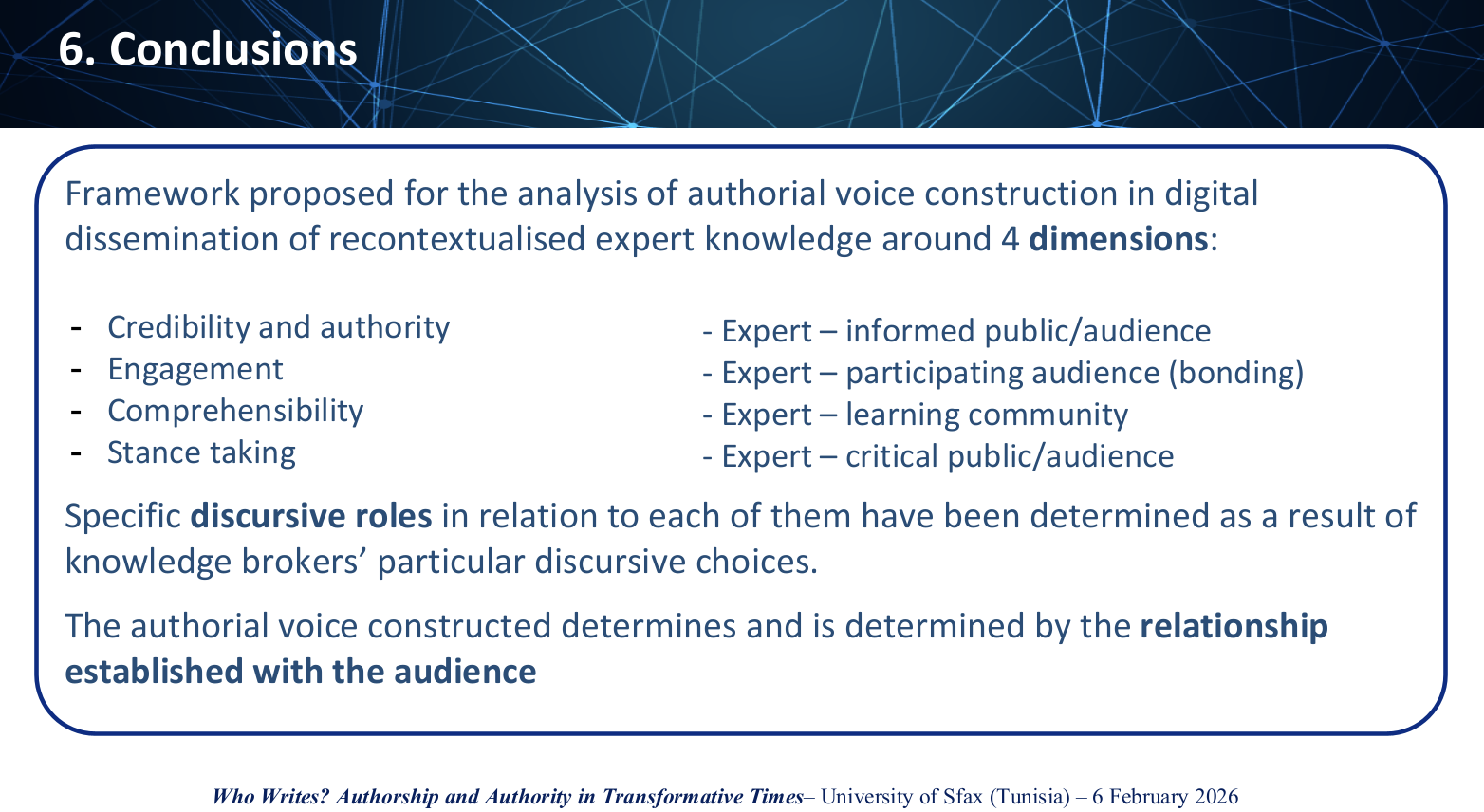
In her plenary speech, Dr Mur-Dueñas threw light on issues related to the way in which authorial voices are crafted and projected when disseminating expert knowledge in the digital milieu. She examined and contrasted how these voices are manifested in author-generated and writer-mediated expert knowledge dissemination in the fields of Economy and Natural Sciences, alongside the discursive roles they perform across these two different types of practices based on knowledge brokers’ discursive choices.
Learn more about her thought-provoking plenary speech through her abstract below:
Authorial Voices in Digital Expert Knowledge Dissemination: Discursive Roles and Audience Relationships
Digital media have transformed both the production of specialised expert knowledge and the ways in which it is disseminated and accessed. Within this digitally mediated landscape, knowledge brokers (both experts, i.e. scientists/scholars and mediators, i.e. journalists and scriptwriters) occupy a central role in making scientific knowledge accessible, understood and accepted by diverse audiences through a wide range of digital textual practices. In our research group, InterGEDI, we focus on the linguistic, pragmatic, and multimodal analysis of how specialised knowledge is recontextualised in digital environments taking advantage of the affordances of online media.
In order to better understand these practices we compiled the SciDis (Scientific Dissemination) database comprising digital texts and practices associated with three areas-Health, Economy, and Natural Sciences-where the dissemination of knowledge is assumed to be particularly prominent, given their relevance to the public and their significant social implications. The database distinguishes between social media practices and web-hosted practices, as well as between author-generated and writer-mediated practices (Pascual and Sancho Ortiz 2024).
Previous research has highlighted the key role of explanatory, engagement and credibility strategies in the recontextualisation of expert knowledge for audiences with varying levels of expertise (e.g. Lorés 2023, 2024; Mur-Dueñas, 2024; Sancho-Ortiz 2025). Through these strategies, knowledge asymmetries between experts and non-experts (Engberg, 2016; Maier & Engberg, 2021) can be bridged, thereby fostering a more democratised access to scientific knowledge.
This talk focuses specifically on how authorial voices are constructed and projected in two types of digital recontextualision practices across two fields (Economy and Natural Science): 1) texts published in the expert knowledge communication platform The Conversation, authored by experts themselves (scientists and scholars), and 2) research digests authored by knowledge mediators (journalists and scriptwriters) and published in two different sites: Science Daily and the European Commission. By drawing on this subset of our SciDis corpus consisting of a total of 40 texts, I will explore the cognitive discursive choices made by one and the other type of knowledge brokers and how these shape diverse identities in the digital texts, ranging from explainer, arguer, reporter and narrator to arouser of interest, entertainer and engager. The analysis of specific discursive realisations will guide the identification of when and how these roles are enacted. It will be shown that authorial voices constructed contribute to building specific relationships with their potential audiences. In doing so, the study sheds light on the process of social reposition, that is, the reconfiguration of the relationship between addresser and audience (Bezermen and Kress 2008) in the digital recontextualization of expert knowledge.
References
Bezemer, Jeff A. and Kress, Gunther. (2008). Writing in multimodal texts: a social semiotic account of designs for learning. Written Communication 25(2), 166-195. https://doi.org/10.1177/0741088307313177
Engberg, Jan. (2016). Conceptualising corporate criminal liability: Legal linguistics and the combination of descriptive lenses. In Tessuto, G. et al. (eds.), Constructing legal discourses and social practices: Issues and perspectives. Cambridge Scholars Publishing: 28-56.
Engberg, Jan. (2021). Prologue. In Pontrandolfo, G., & Piccioni, S. Comunicación especializada
y divulgación en la red. Aproximaciones basadas en corpus. Routledge: vii- x.
Lorés, Rosa. (2024). Digesting psychology: Metadiscourse as a recontextualizing tool in the
digital communication of disciplinary research. Chinese Journal of Applied Linguistics 47 (2): 178-195. https://doi.org/10.1515/CJAL-2024-0202
Lorés, Rosa. (2023). Dual voices, hybrid identities: The recontextualization of research in digital
dissemination scientific discourse. Círculo de Lingüística Aplicada a la Comunicación 93: 69-84. https://doi.org/10.5209/clac.85566
Mur-Dueñas, Pilar. (2024). Digital dissemination practices: An analysis of explanatory strategies
in the process of recontextualising specialised knowledge. Discourse & Interaction 17 (1): 94-114. https://doi.org/10.5817/DI2024-1-94
Pascual, Daniel & Sancho-Ortiz, Ana Eugenia. (2024). Investigating recontextualisation
processes in scientific digital practices: The SciDis Database. Revista Electrónica de Lingüística Aplicada 23: 101-118. https://doi.org/10.58859/rael.v23i1.649
Sancho-Ortiz, Ana Eugenia. (2025). Environmental discourse on social media: Exploring
engagement in X/Twitter for environmental purposes. Language & Dialogue 15(1), 105-133. https://doi.org/10.1075/ld.00189.san