
UPCEL 2026: Luis Martínez-Kleiser explores multimodal scientific discourse and its affordances for EFL
Our team member Luis Martínez-Kleiser participated in the 6th International UCM Predoctoral Conference on English Linguistics (UPCEL), organised by the PhD Programme in English Linguistics of Universidad Complutense de Madrid (UCM). The conference took place at UCM’s Faculty of Philology on the 21st, 22nd and 23rd of January 2026. This sixth edition had “Expanding the horizons of English Linguistics” as its motto, offering a programme rich in diverse research perspectives.
His comprehensive presentation was titled “Analysing recontextualised knowledge for adolescents: Bringing multimodal scientific discourse into the EFL classroom”. The paper reported on both quantitative and qualitative insights into how credibility, comprehensibility and engagement are multimodally built in scientific texts for adolescents.
For more information about his presentation, you can have a look at his abstract below:
Analysing recontextualised knowledge for adolescents: Bringing multimodal scientific discourse into the EFL classroom
Adolescents are consumers of online information on issues such as climate change, renewable energy, nutrition, and health. This context matches science knowledge generators’ desire to popularise their research and the need to find reliable sources of information (Lorés, 2023) on behalf of teenage audiences. Making research accessible to diverse audiences requires a process of recontextualisation, which plays a crucial role in the task (Lorés & Mur-Dueñas, 2025). How that is done for adolescent audiences deserves attention.
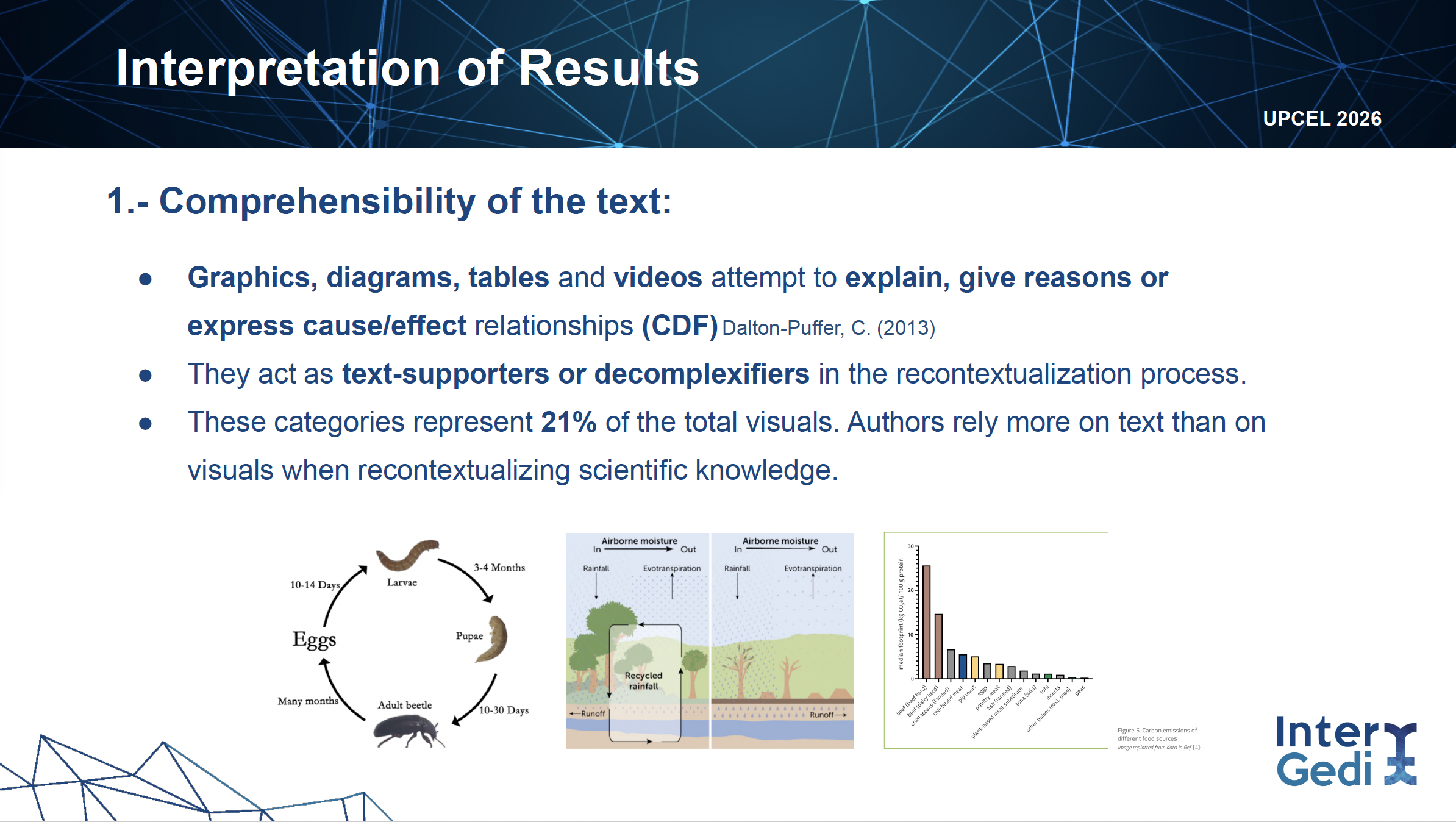
This paper aims to present the main discursive and multimodal strategies used to make scientific findings on teenage-oriented websites accessible to their targeted audience. The frequency of use and function of explanatory strategies (Mur-Dueñas, 2024), drawing on the framework of cognitive discourse functions (Dalton-Puffer, 2013) and how these contribute to giving reasons or providing causes for certain scientific phenomena, will be part of the study. The use of engagement strategies in these texts will also be presented (Hyland, 2005). Finally, the role of multimodality, the integration of different semiotic modes (Bezemer & Kress, 2008), and the contribution of visual elements to extend or elaborate knowledge (Van Leeuwen, 2005) will also be explored and discussed.
A corpus of 30 texts from adolescent-targeted websites was compiled. SciDisTA corpus (Scientific Dissemination for Teenage Audiences) is part of the SciDis database compiled by the InterGEDI research group. SciDisTA contains texts in which Natural Science and Health research is disseminated, including links to the original academic sources and proper acknowledgement of authorship.
Results show the impact of explanatory strategies as a cognitive discourse function in the recontextualisation process, as well as the key function of directives and questions to generate engagement. Semiotic resources such as visuals, layout, and colours are found to play a significant role in making information accessible for teenage audiences.
Conclusions will be provided regarding patterns found to recontextualise knowledge for adolescents. The suitability of these texts to be brought into the EFL classroom and the need to provide teacher training to help students fully develop multimodal communicative competence will also be discussed.
References
Bezemer, J., & Kress, G. (2008). Writing in multimodal texts: A social semiotic account of designs for learning. Written communication, 25(2), 166-195.
Dalton-Puffer, C. (2013). A construct of cognitive discourse functions for conceptualising content-language integration in CLIL and multilingual education. European Journal of Applied Linguistics, 1(2), 216-253. https://doi.org/10.1515/eujal-2013-0011
Hyland, K. (2005). Stance and engagement: A model of interaction in academic discourse. Discourse studies, 7(2), 173-192.
Lorés, R. (2023) ‘Dual voices, hybrid identities: the recontextualization of research in digital dissemination scientific discourse.’ Círculo de Lingüística Aplicada a la Comunicación 93, 69-84. https://doi.org/10.5209/clac.85566
Lorés, R. & Mur-Dueñas, P. (2025). (eds). Mediating scientific knowledge for diverse audiences on digital platforms. Special Issue Context Discourse and Media.
Mur-Dueñas, P. (2024). Digital dissemination practices: An analysis of explanatory strategies in the process of recontextualising specialised knowledge. Discourse and Interaction, 17(1), 94-114. https://doi.org/10.5817/di2024-1-94
Van Leeuwen, T. (2005). Multimodality, genre and design.In R. H. Jones & S., Norris. (2005), Discourse in Action: Introducing Mediated Discourse Analysis (1st ed.)(pp. 73-93). Routledge. https://doi.org/10.4324/9780203018767