
UPCEL 2026: Alba Ansó-Millán discusses discursive dimensions and strategies in science dissemination
Our PhD student Alba Ansó-Millán presented at the 6th International UCM Predoctoral Conference on English Linguistics (UPCEL), which took place over the span of three days, between January 21st and 23rd, 2026. The conference was organised by the PhD Programme in English Linguistics of Universidad Complutense de Madrid (UCM) and was held in its Faculty of Philology. This year's edition attracted researchers with diverse interests in line with the event's motto, namely "Expanding the horizons of English Linguistics".
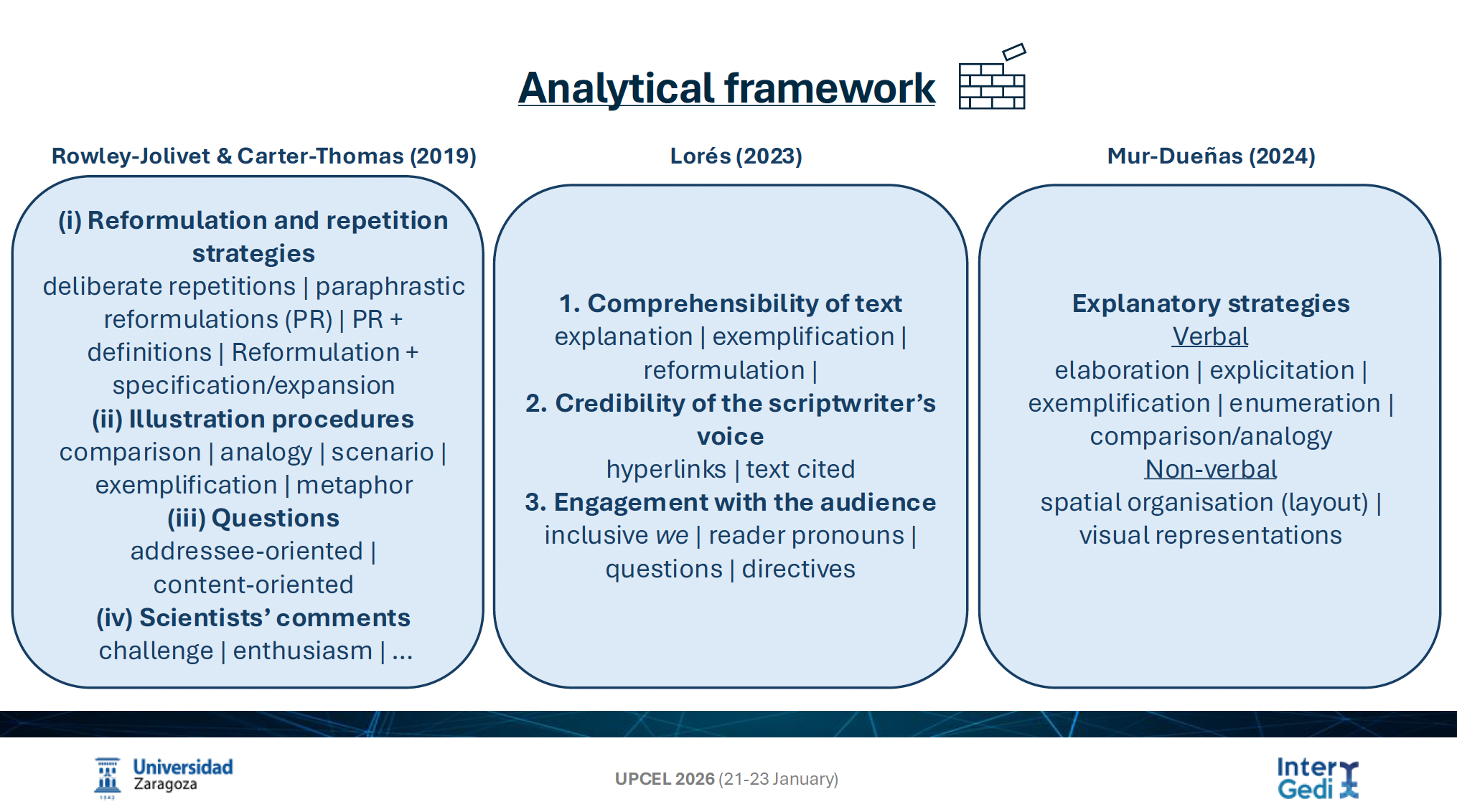
As the title of her talk suggests, "Research-based knowledge transfer in science podcasts: A working taxonomy of discursive dimensions and strategies", she shared and discussed the elements of a taxonomy of recontextualisation mechanisms found in health- and environmental-related science podcasts.
You can find the abstract of her presentation below:
Research-based knowledge transfer in science podcasts: A working taxonomy of discursive dimensions and strategies
Research-based knowledge communication has ceased to rely solely on horizontal, peerto-peer exchanges to become public-oriented (Curry & Pérez-Paredes, 2025). Scholars are committed to not only engaging in primary output, but also in external communication to the general public (Mur-Dueñas, 2021). Consequently, discursive practices are evolving to enable the transfer of specialised knowledge to contexts where varying degrees of expertise co-exist in an “unstable audience” (Herrando-Rodrigo, 2014: 46). These settings trigger “knowledge asymmetries” (Engberg et al., 2024) that are complex to recognise and that affect how discourse is crafted for knowledge to be understood and accepted. One digitallymediated context facing such discursive challenges is the science podcast, available and addressed to experts and non-experts alike. This paper thus seeks to add to the growing body of literature into knowledge transfer discourse by analysing this practice that, despite its popularity, remains under-studied from the applied linguistic field thus far (Ansó-Millán, 2025; Liu & Jiang, 2024). The following questions guided this study:
(1) How is research-based knowledge recontextualised in science podcast discourse?
(2) What mechanisms are employed to make specialised knowledge potentially accessible to the target audience, given their varying domain-specific degrees of expertise?
To investigate them, a dataset of podcast episodes from Science Friday and BBC Inside Science was compiled and analysed taking an onomasiological, functional-linguistic approach. The coding process was software-aided by LancsBox and NVivo. Building on published studies (Lorés, 2023), the findings yielded a four-dimensional taxonomy encompassing different discursive mechanisms. It was observed that in transferring specialised knowledge to the broad digital audience, the podcast host and the expert guests resorted to a wide range of strategies – e.g. evidentials, elaborations, references to sharedness – that could be classified into four dimensions aimed at ensuring the reliability of specialised knowledge (Credibility) and its accessibility (Comprehensibility), whilst simultaneously eliciting the audience’s simulated response (Prompting) and appealing to their reciprocity (Affinity). Follow-up work will be aimed at refining and operationalising this working taxonomy by compiling a larger corpus of science podcasts and extrapolating these insights to other knowledge transfer practices – e.g. TheConversation posts.
References
Ansó-Millán, Alba. (2025). Analysing the discourse of knowledge transfer practices: A study of proximity in psychology-related podcasts. Complutense Journal of English Studies, 33, e98191.
Curry, Niall & Pérez-Paredes, Pascual. (2025). Exploring public-oriented research communication: A register perspective. Register Studies, 1-31. https://doi.org/10.1075/rs.25008.cur
Engberg, Jan, Fage-Butler, Antoinette & Kastberg, Peter. (2023). Perspectives on knowledge communication: Concepts and settings. Routledge.
Herrando-Rodrigo, Isabel. (2014). Genre evolution in research communication in English. Revista Canaria de Estudios Ingleses, 69, 35-49.
Liu, Luda, & Jiang, Kevin. (2024). Podcasting science: Rhetorical moves and interactional metadiscourse in the Nature Podcast. Journal of English for Academic Purposes, 71, 101419.
Lorés, Rosa. (2023). Dual voices, hybrid identities: The recontextualization of research in digital dissemination scientific discourse. Círculo de Lingüística Aplicada a la Comunicación, 93, 69-84.
Mur-Dueñas, Pilar. (2021). Engagement markers in research project websites: Promoting interactivity and dialogicity. Poznan Studies in Contemporary Linguistics, 57(4), 655-676.