
AESLA 2026: Daniel Pascual examines expert discourse construction in Ask-an-Expert websites
Our team member Dr Daniel Pascual participated at the 43º Congreso Internacional de la Asociación Española de Lingüística Aplicada (AESLA), which was celebrated from April 15th to April 17th 2026, taking place at the University of Granada. The conference’s motto centred on “Lengua, variación e identidad: dinámicas lingüísticas para representar la sociedad“.
Daniel’s paper was titled “The construction of expert discourse in Ask-an-Expert websites on climate and nutrition”. Through a data-driven approach, he observes the use of ten different verbal explanatory strategies and identifies topic-specific choices and trends.
Find out more about his abstract below:
The construction of expert discourse in Ask-an-Expert websites on climate and nutrition
In today’s information-saturated landscape, digital practices play a central role in constructing expert discourse. The vast availability of online data, from rigorously peer-reviewed research to user-generated content, creates both opportunity and noise. Navigating this growing chaos demands trustworthy, specialized sources capable of filtering misinformation and maintaining credibility. Ask-an-Expert websites, defined as web-based platforms where users pose questions to verified professionals about
socially relevant topics and disciplines (Pascual 2025), exemplify a constructive counterbalance to the spread of unvetted information. These spaces merge authoritative knowledge with accessibility, preserving epistemic rigor while fostering direct interaction between experts and the wider public. Their communicative value lies in the quality and accuracy of the information circulated (Pounds 2018), while their personalized and contextualized nature enhances both affective and cognitive engagement among users (Ocepek and Westbrook 2015). Consequently, Ask-an-Expert websites illustrate yet another scenario in which experts recontextualize disciplinary knowledge, making it digestible for heterogeneous audiences (Lorés 2024).
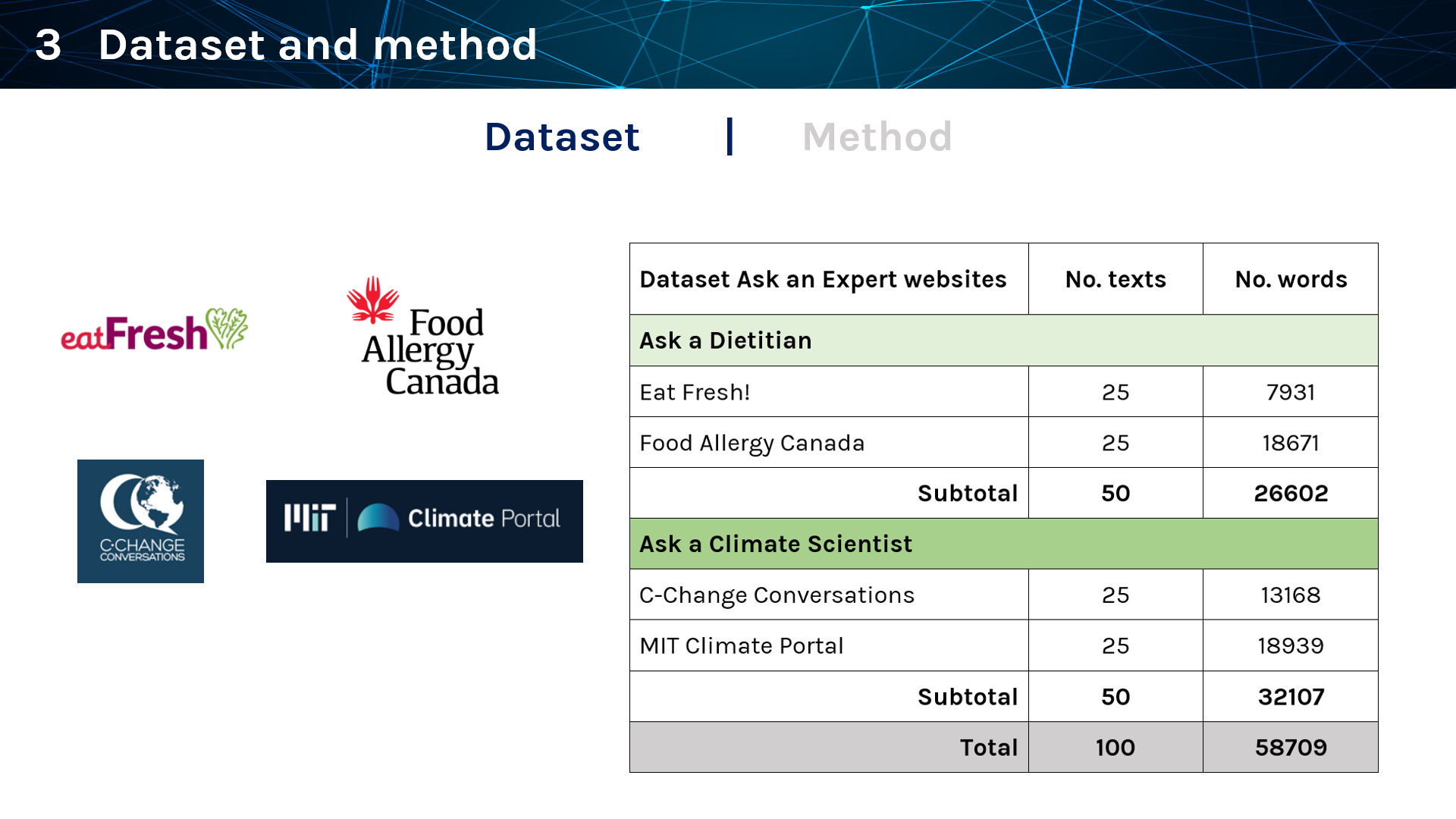
Against this backdrop, the present paper examines how experts construct their discourse in Ask-an-Expert websites across two specific disciplines, climate and nutrition, by analyzing the verbal explanatory strategies they employ. To this end, a corpus of 100 Ask-an-Expert texts was compiled and analyzed using NVivo. The corpus, which stems from the SciDis Database containing representative examples of
digital practices for scientific dissemination and knowledge transfer (Pascual and Sancho-Ortiz 2024), comprises texts from four dedicated websites: two focused on climate (C-Change Conversations and the MIT Climate Portal) and two on nutrition (Eat Fresh and Food Allergy Canada), with 25 entries selected from each source. A taxonomy of ten verbal explanatory strategies was developed following a data-driven approach, informed by previous research (e.g., Cavalieri and Diani 2019; Mur-Dueñas 2024), and applied to the corpus.
Results reveal both similarities and differences across disciplines. Elaboration, explicitation, and definition appear to be pervasive features of Ask-an-Expert texts, facilitating the concretization of abstract ideas and the unpacking of complex concepts to strengthen shared understanding between experts and readers. Conversely, metaphor and attribution are more prominent in climate-related texts, whereas enumeration and exemplification occur more frequently in nutrition-focused ones. Representative examples of these discursive processes are discussed to illustrate their communicative functions within each disciplinary field. Overall, the study aims to enhance researchers’ and scientists’ awareness of their digital practices and to promote the conscious use of discursive strategies when bridging disciplinary
References
Cavalieri, S. & Diani, G. (2019). Exploring health literacy. Web-based genres in disseminating specialized knowledge to caregivers. The case of paediatric neurological disorders. Lingue Culture Mediazioni/ Languages Cultures Mediation, 6(1), 89-105. https://doi.org/10.7358/lcm-2019-001-cadi
Lorés, R. (2024). Digesting psychology: Metadiscourse as a recontextualizing tool in the digital
communication of disciplinary research. Chinese Journal of Applied Linguistics, 47(2), 178–195. https://doi.org/10.1515/CJAL-2024-0202
Mur-Dueñas, P. (2024). Digital dissemination practices: An analysis of explanatory strategies in the process of recontextualising specialised knowledge. Discourse and Interaction, 17(1), 94–114. https://doi.org/10.5817/DI2024-1-94
Ocepek, M.G., & Westbrook, L. (2015). Question, answer, compare: A cross-category comparison of answers on question and answer websites. New Review of Hypermedia and Multimedia, 21(3–4), 212-226. https://doi.org/10.1080/13614568.2015.1036134
Pascual, Daniel. (2025). Dialogic markers in Ask an Expert webpages on environmental discourse. Language & Dialogue 15(1), 156-181. https://doi.org/10.1075/ld.00191.pas
Pascual, Daniel & Sancho-Ortiz, Ana Eugenia. (2024). Investigating recontextualisation processes in scientific digital practices: The SciDis Database. Revista Electrónica de Lingüística Aplicada 23, 101-118. https://doi.org/10.58859/rael.v23i1.649
Pounds, G. (2018). Patient-centred communication in Ask-the-Expert healthcare websites. Applied Linguistics, 39(2), 117–134. https://doi.org/10.1093/applin/amv073