
7ICLHEspain: Vicky Gil discusses how to adapt teacher training to present-day requirements
Team member Dr Vicky Gil participated in the 7th International Symposium GR ICLHE-Spain, which was themed around “New horizons in language policy: enabling content and language integration in Higher Education”. The 2026 Symposium took place at the University of Córdoba on the 28th and the 29th of April.
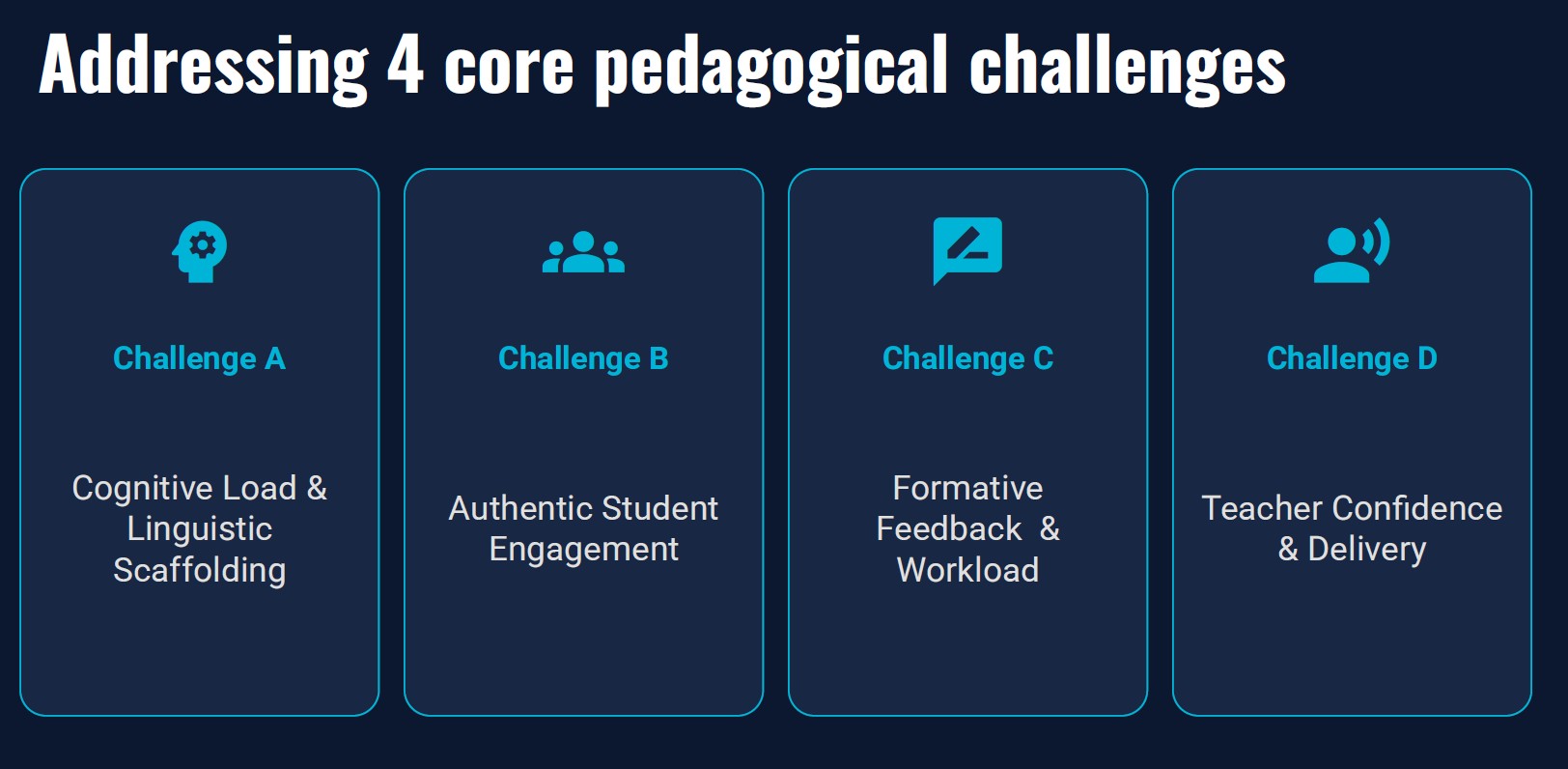
Her paper was titled “Responding to change in ICLHE teacher training: Integrating language, pedagogy and technology”. There, she primarily aimed to present recent adjustments that have been made to tailor courses to new instruction challenges and needs, including how to harness AI-tools.
More information about her abstract can be found below:
Responding to change in ICLHE teacher training: Integrating language, pedagogy and technology
As part of our institution’s internationalization policy, teacher training has been offered for over seven years as a central element in the effective implementation of ICLHE instruction. This training combines language development with methodological support and pedagogical innovation, embracing multimodality and multiliteracies, and ongoing technological advances. As with any professional development initiative, such training requires continuous review and revision of course design, syllabi, learning tasks, and the tools employed.
As designers and practitioners of the ICLHE training itinerary at our institution, the aim of this paper is to present recent developments in course design and redesign in response to emerging pedagogical and technological needs. In particular, we discuss concrete examples of how existing courses have been adapted and how new courses are being developed to take advantage of the affordances of AI.
By integrating a critical use of multimodal generative AI in the training program, we seek to raise ICLHE teachers’ awareness of its potential, not only as a support for lesson planning, assessment design, and materials development, but also as resource for creating multimodal resources and materials that foster student engagement and deeper learning, promoting more effective EMI classrooms. At the same time, we address the need to develop teachers’ critical literacies regarding the use of AI for teaching purposes.
Overall, we argue that as trainers we need to do our best to meet the needs of ICLHE teachers and adjust to the changes in our local and global context. An integration of language, methodological and technological skill development is key to engaging current and future EMI teachers in their professional training and supporting sustainable ICLHE practices at our institution.