
7ICLHEspain: Pilar Mur-Dueñas co-analyses teachers’ language challenges in EMI
Dr Pilar Mur-Dueñas and Irene Puente contributed an oral paper to the 7th International Symposium GR ICLHE-Spain. This edition centred on “New horizons in language policy: enabling content and language integration in Higher Education” and was carried out on-site at the University of Córdoba, on April 28th and 29th, 2026.
The title of their paper was as follows, “English-medium education teachers’ perceptions of their language skills at a Spanish university: Perceived challenges and readiness”. There, Mur-Dueñas co-analysed teachers’ responses to a questionnaire in order to identify common perceived challenges affecting English Medium Instruction in the context of a Spanish University.
Learn more by reading their abstract below:
English-medium education teachers’ perceptions of their language skills at a Spanish university: Perceived challenges and readiness
Teachers’ language competence is frequently viewed as a key component for effective EMI instruction. There is ongoing debate regarding the level of English proficiency required of instructors, and whether, or how, such proficiency should be certified in higher education. However, general English proficiency alone may not be a sufficient indicator of teachers’ readiness to undertake EMI successfully, as academic and disciplinary literacies in the foreign language are equally, if not more important.
This paper analyses teachers’ perceptions at our institution of their own language skills and the challenges they face when teaching through English, with the aim of identifying trends and patterns that can inform the evaluation and adjustment of training offered.
We analyse responses to the questionnaire “English-medium education teachers’ views on language related challenges” (led by Professor Hans Malmstrom from Chalmers University of Technology) completed by 60 teachers at our university in June 2025. We explore possible correlations between self-reported English language proficiency, teaching experience (both general and EMI), and perceived preparedness for teaching in the foreign language, while also considering gender and discipline.
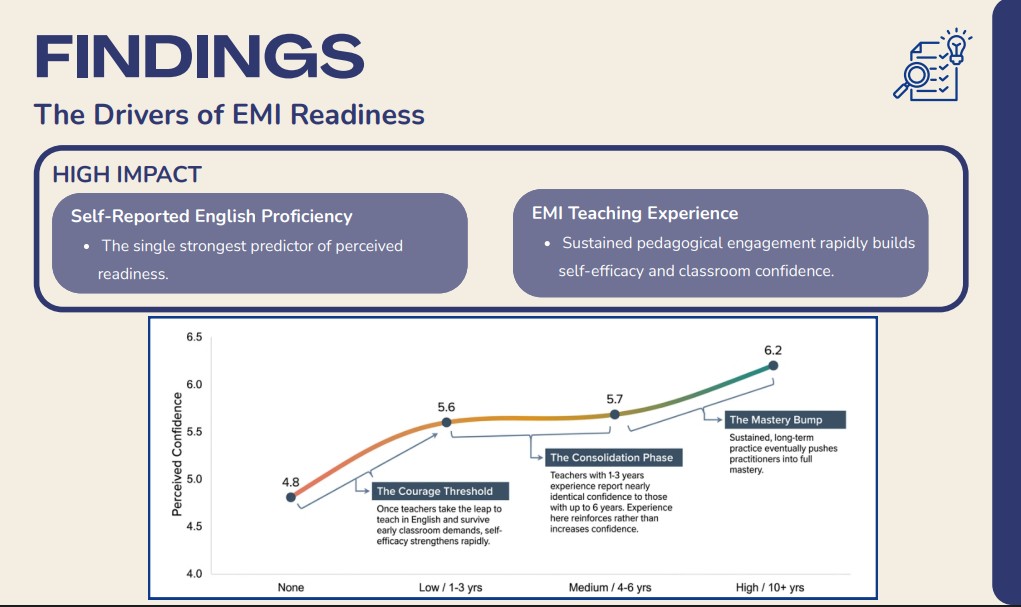
Results show that teachers report lower confidence in oral productive skills, particularly extended spoken production involving disciplinary explanations, sustained fluency, and spontaneous academic discourse. In addition, higher levels of perceived readiness are strongly associated with greater English proficiency and more extensive EMI experience. No significant differences emerge across disciplines or gender. Responses further suggest that even teachers with more than 6 years of general teaching experience and some EMI training continue to perceive challenges to their readiness. Overall, EMI experience appears to be a strong predictor of teacher confidence and perceived preparedness.
To encourage teachers to engage in EMI, and build experience and confidence, training should integrate language and pedagogical skills, with particular attention to oral fluency in academic delivery and spontaneous interactions, and be tailored to their specific contexts, and perceived challenges and needs.